


THE BREAKDOWN: The real reasons why Enzo Maresca's Man City can't stop losing - from anonymous Enzo Fernandez abandoning Elliot Anderson, to the fatal flaws in Italian's set-up that are being brutally exposed
Nov 23 2026 09:18 · بواسطة James Sharpe · 11 عدد المشاهدات


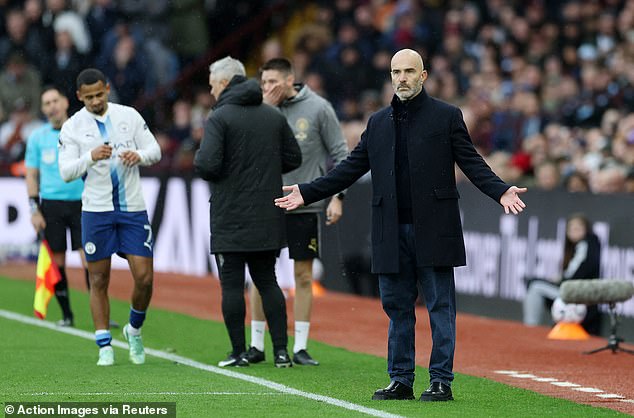
Diet Pep is losing his fizz. Enzo Maresca may look like Pep Guardiola, may have learned his craft under his Manchester City predecessor, but his quest to follow in his mentor’s footsteps has all gone a bit flat.
Seven successive Premier League wins to start his City reign, a record for a new manager in the competition, breaking one jointly-held by Guardiola, gave the impression that this might be a smooth passing of the torch after all.
Three months in, and three defeats on the spin that left them six points behind Arsenal have made it clear that something is not clicking for Maresca.
Is the uncertainty around the potential punishment following that guilty verdict taking its toll? Is Maresca just suffering from his usual late autumn dips? He suffered similar tricky periods around late October and early November at Leicester and his first season at Chelsea too.
Or is there something at the heart of his side, of his system, that’s finally being exposed?
Enzo Maresca's Man City have slumped to three straight Premier League defeats after a promising start to the season
COUNTER CHAOS
Guardiola’s City was all about control. Keep the ball, dominate the pitch, play the game at your pace, on your terms.
Maresca’s City, regardless of how well they started the season, has been about anything but. It has been about triumph amid chaos, about moments of magic more than the overarching method.
Without that control, City’s defensive issues have been laid bare. The 13 goals they have let in after 10 games is their most at this stage since 2008. They haven’t kept a clean sheet in their last eight matches in all competitions. That's a drought longer than at any point under Guardiola.
Their biggest problem over City's three successive Premier League defeats is just how susceptible they have been to counter attacks.
Only Newcastle have faced more shots this season following ‘fast breaks’ – data giants Opta's term for counter attacks – than City’s 17, and 11 of those have come in the last three games: six against Nottingham Forest, two of which led to goals, three against Brighton and another two against Aston Villa.
Maresca’s side are being more profligate in possession, too. Over the first seven games of the season, they lost the ball 120 times a game on average – one of the best figures in the division. Since then, it’s closer to 140.
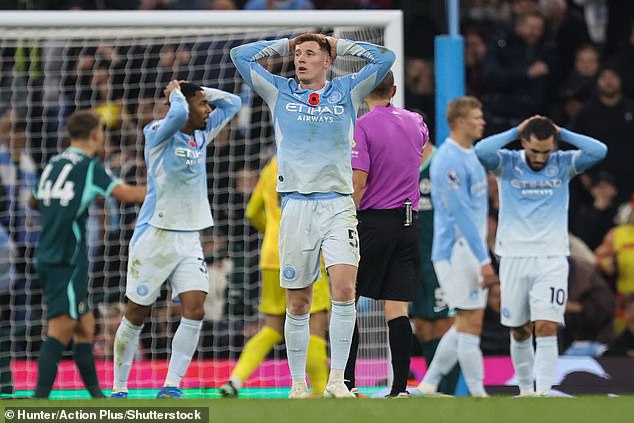
City have been wasteful in possession and regularly overrun on the counter, with Elliot Anderson (centre) too often left isolated in midfield
ANDERSON CAN'T DO IT ALL ON HIS OWN
Many of these problems have their roots in Maresca's serious problems in midfield. Rodri, the best holding midfielder of his generation, was always going to be hard to replace but Maresca appears to be expecting Elliot Anderson to do it all on his own.
Anderson is at his best when he’s free to get up and down the pitch, box to box, using his physicality not just in winning the ball back but progressing it. No midfielder played more passes into the final third last season than Anderson at Forest. At one stage of the campaign, he had played more progressive passes than any other player across Europe’s top five leagues.
And yet Maresca is forcing Anderson to play as the sitter while his golden boy Enzo Fernandez, whom he pushed City to sign in the summer for £125million, is roaming free and high up the pitch.
Maresca likes his teams to build up in a 3-1-6 shape, which sees Fernandez push up as an extra attacking midfielder, and leaves Anderson manning the fort alone.
When City lose the ball, though, it leaves them wide open.
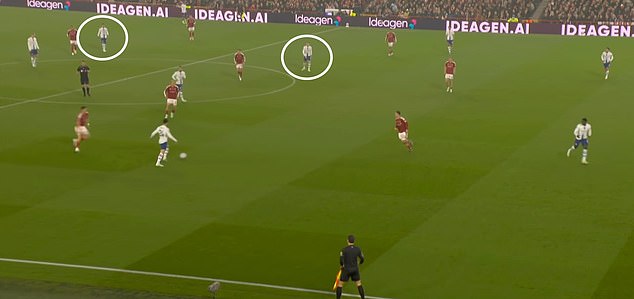
This is the opening goal City conceded against Forest. Josko Gvardiol wants to play the ball inside but has only red shirts and empty green space ahead of him. Anderson is the only man free, but even he is too high and has a Forest player ready to cut off the pass. Eventually, Gvardiol gets robbed and Forest score.
A lack of options for Josko Gvardiol (left) led to Forest's opener against City. Enzo Fernandez (circled) was caught high up the pitch, way ahead of the deeper Anderson (also circled)
Here’s another moment in the defeat by Brighton.
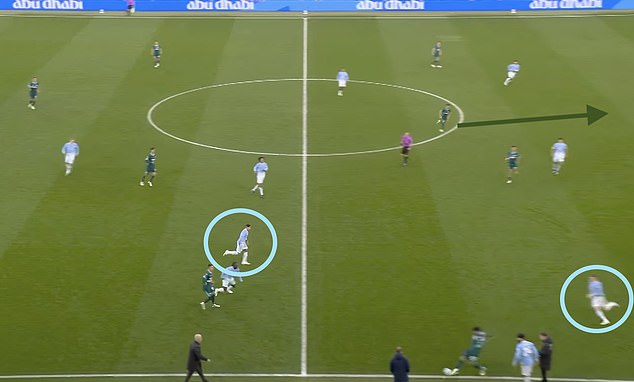
The Seagulls break forward on the flank and Anderson races over to close the ball down. Fernandez is, you guessed it, high up the pitch.
City have no midfield cover to stop the ball inside, Abdukodir Khusanov gets drawn in and leaves loads of space in behind for Yasin Ayari to exploit and cross to Maxim De Cuyper for a great chance.
The lack of protection offered by Anderson and especially the more advanced Fernandez was again on show against Brighton, who were able to exploit the acres of space left in midfield
Fernandez is doing what Maresca wants, but it’s not working. Maresca needs more from him, especially when Anderson’s instincts are to press and harass and bully, which can leave gaps when he does not yet read the game as comprehensively as Rodri.
Anderson sits in the top five for ball recoveries among midfielders to have played 500 minutes this season. Fernandez is in the bottom five. That figure becomes even more alarming when you consider Anderson has created more chances from open play than Fernandez, too.
Ayyoub Bouaddi showed at the World Cup that he had the most similar profile to Rodri. It might be time for Maresca to put some faith in him.
DONNARUMMA IN THE DUMPS
Maresca has always wanted his goalkeeper to be an 11th outfielder. In his one season at Leicester, Mads Hermansen played more passes than any goalkeeper in Championship history. During his time at Chelsea, there was a shaky moment in a draw with Arsenal when loud groans greeted a misplaced pass from Robert Sanchez.
‘I am the guy who asks Robert to do that,’ said Maresca after that game. ‘The moment he stops doing that, he is not going to play.’
Donnarumma, though, for all his (usually) excellent shot-stopping, is anything but a ball-playing goalkeeper. The ball rolled under his foot from a simple back pass against Coventry and so nearly crept over the line. He gifted France an early lead while on international duty with Italy when he passed the ball straight to Michael Olise.
Only two keepers made more errors leading to shots than Donnarumma across the course of last season, with many of those being with his feet, like when he gifted Kai Havertz an equaliser in City's victory over Arsenal in April.
Gianluigi Donnarumma has never been good with his feet - now his excellent shot-stopping has taken a dip too
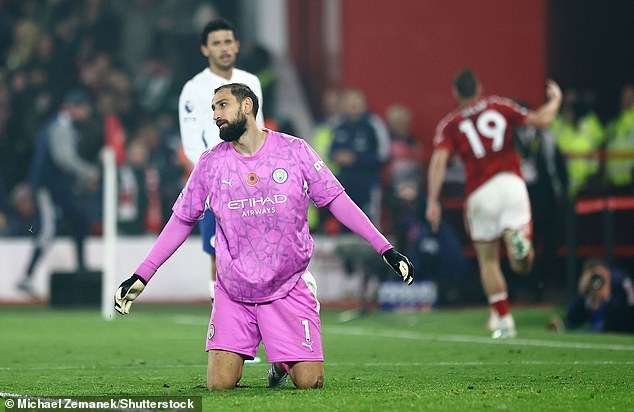
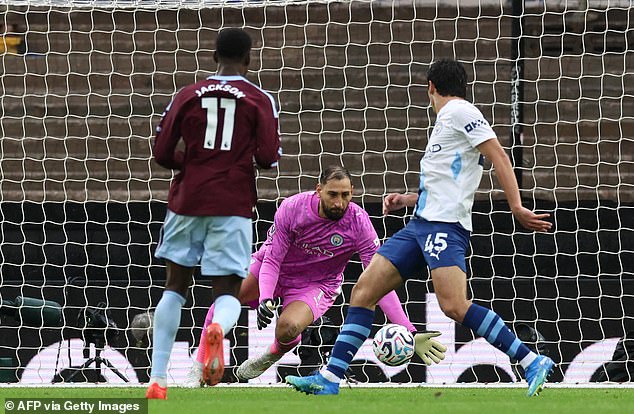
The Italian should have easily dealt with Nicolas Jackson's second goal in City's 2-1 loss at Aston Villa
The decision to let James Trafford leave in the summer, especially with Guardiola’s impending departure and a manager like Maresca coming in, is looking ever more misguided.
Trafford is not immune to mistakes either, of course. He erred badly when trying to play out from the back for City against Spurs last season and made an almost identical howler for Leeds at Bournemouth in October. But he is still far more confident at playing out from the back than Donnarumma.
The double blow for Maresca is that the trade-off with Donnarumma – where he makes up for his weakness with the ball at his feet by making saves that other keepers can’t make – is no longer paying off either.
Nicolas Jackson’s shot squirmed straight through him to hand Villa victory and condemn City to their first defeat of the season.
When you are coughing up chances as frequently as City are, Maresca needs his keeper to be on top form.
Do you know who is keeping the ball out of his net? James Trafford. He boasts the highest save percentage of any goalkeeper in the top flight, keeping out 81 per cent of the shots on target coming his way. Donnarumma is 15th, on less than 66 per cent.
According to Opta’s expected data, Trafford has also prevented more than four goals that he should have conceded from the quality of the shots he’s faced. Again, he’s the best in the Premier League. Donnarumma is middle of the pack.
‘At the moment, I’m not thinking about the goalkeeping situation,’ said Maresca recently. Without Trafford there and just 34-year-old Geronimo Rulli as back-up, he doesn’t really have a choice but to persist with Donnarumma and hope he improves.
HAALAND'S WELL RUNNING DRY
When the goals stop flowing for Erling Haaland, City can't mask all their other problems.
So used are we now to seeing the Norwegian on the scoresheet, having notched nine in City’s opening eight matches, that when he goes just two games without a goal it feels as if he’s on a barren spell.
The issue, though, is less down to Haaland and more that City’s build-up in recent weeks is struggling to get him into the game.
City are finding it more difficult to get Haaland on the ball. His touches per game are falling steadily but, crucially, so are the quality of the chances his team-mates are creating for him.
Haaland had more than one Opta-defined 'big chance' in five of City’s opening seven games. He’s had just one come his way in each of their three defeats.
His expected goals (xG) tally is dropping too. Across City’s winning streak, Haaland’s average xG per match was 0.81. Only once, against Liverpool, did it drop below 0.5.
Over the three defeats, it’s just 0.45 and has not once gone above 0.5.
Antoine Semenyo missing the last three games through injury has not helped, especially when teams now try to pack the middle of the pitch and force City wide.
Haaland will come good, he always does, but City need to start serving him again if Maresca wants to get through this tricky spell and stop the vultures from circling.