


The Athletic: Inside Chris Finch’s world with the Timberwolves
Nov 12 2026 18:48 · Par Jon Krawczynski, The Athletic · 58 Lectures


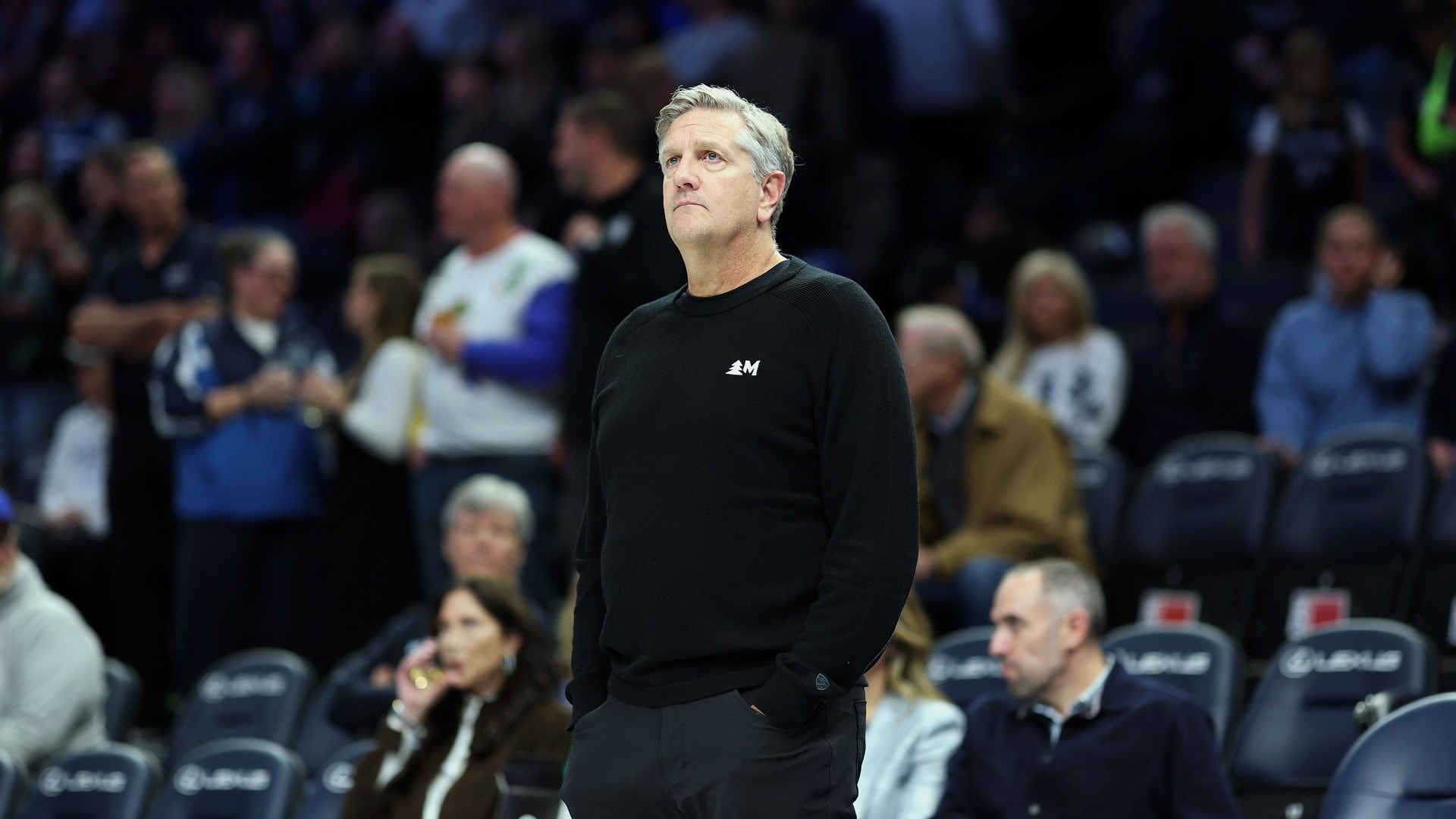
Minnesota Timberwolves coach Chris Finch enters his sixth full season at the helm.
Editor’s Note: Read more NBA coverage from The Athletic
here
. The views on this page do not necessarily reflect the views of the NBA or its teams.
* * *
MINNEAPOLIS —
On a warm October morning ahead of the Minnesota Timberwolves’ lone home preseason game, Chris Finch sits behind a large desk in his office, a plethora of note cards and papers spread out in front of him.
They are filled with jottings that pop into his head at all hours. An offensive set that could work against that night’s opponent. A lineup he wants to try in the second quarter. A point he thinks is important to make in the coach’s meeting that day.
The penmanship is neat and very, very small, allowing him to cram thought after thought onto each card. One might believe Finch chases efficiency in his note-taking the same way he does in his half-court offense. If only it were that poetic.
He writes that way because of a condition called hemochromatosis, a hereditary disorder in which the body absorbs and stores too much iron. Finch treats it with periodic phlebotomy, in which a pint of blood is removed to lower his iron levels. The condition causes joint pain in Finch’s fingers, making his writing illegible if he tries to make the words bigger.
“I can control it when it’s small,” he said. “If I try to write bigger it can get away from me.”
The notes are plentiful because there is a lot going on as the season approaches. He has a new point guard and a new power forward in his starting lineup, a new lead assistant on his staff and a new owner calling the shots. Finch finds the uncertainty that comes with change invigorating.
“There’s so much excitement internally,” Finch said. “It just feels like more of a calmer environment in a lot of ways, if that makes sense. It just feels that everybody is in a good place.”
His staff members have noticed a pep in Finch’s step this fall.
“We’ll see as we move forward,” lead assistant Pablo Prigioni says. “When you see the team have potential, your energy is different, your level of excitement is different. We all feel the same way.”
Things were going so well that the little voice in Finch’s head, shaped by decades of coaching in the NBA, started to whisper in his ear. He’s constantly thinking about the adversity that might be waiting around the corner.
“Yeah,” he said. “What’s coming around the corner is the regular season.”
This is a critical season for the Wolves. Anthony Edwards and Jaden McDaniels are entering their primes. Rudy Gobert turned 34 this summer. LaMelo Ball and Jonathan Kuminga have arrived to show, once and for all, that the narratives surrounding them were misguided.
Finch has the highest winning percentage (.576) in franchise history. He is the only Wolves coach to win multiple playoff rounds. The Wolves have won at least 49 games and made it out of the first round in each of the last three seasons, including back-to-back Western Conference finals runs in 2024 and ’25.
The Wolves (8-3) have started Finch’s sixth full season with a bang. That includes three straight wins and an undeniable connection between Edwards and Ball that gave them the look of a real contender.
“I feel like I’m always feeling myself,” Ball said after Minnesota’s 3-0 start. “As long as we winning, I’m feeling myself more.”
But sure enough, just as everything was clicking, the corner arrived. Edwards underwent arthroscopic surgery on his right knee after Game 4, and he will be out for at least two months.
Losing their best player and spiritual tone-setter has placed even more emphasis on a close-knit coaching staff to help the Wolves navigate the coming weeks. Preparation, game plans and adjustments all take on a heightened importance for as long as he is out.
Over two days as the regular season approached, The Athletic went behind the scenes with Finch and his coaching staff as they prepared to make another climb up the Western Conference mountain.
Game day
7:30 a.m.
Some coaches sleep in their office. Others get in at the crack of dawn, sending a message to the rest of the building about the work they expect.
Finch doesn’t go quite that far. He usually arrives a little before 7 a.m. on game days. On practice days, the edict to his coaches is to get their work done and then get out of the gym.
“This is fun,” Prigioni says. “When you work with somebody that, probably, you already know what he’s thinking, it makes it easier. You can get on the same page quicker.”
Finch savors the quiet of an early morning at the facility. This is when he often does some of his best thinking, before the building fills up and players and staff start coming to him for conversations both big and small.
“Once the players start arriving in the facility, and the coaches for that matter, it’s hard to get work done because you don’t know what you’re going to have to deal with,” he says.
The day before, the Wolves held a particularly long practice after an exhibition in New York. Practicing at home the day after a road game is a rare occurrence in Finch’s six years on the job. Usually, they watch some video and stay off their feet. But the coach believes this team needs more on-the-court instruction to build understanding and a feel for each other.
“We’ve gotten a little film-drunk over the last few years,” he says. “I want them to learn by doing.”
He is reviewing clips that his staff put together from the game in New York, finding flaws he wants to correct and good decisions he wants to reinforce.
Finch points to a packet with plays, concepts and strategies that still need to be introduced or tightened up.
“This is all the stuff we’ve got to either review or kind of install before we play Miami,” he says.
These days, he usually gets about five hours of sleep. An alarm is set, but he rarely needs it. His racing mind is all he needs to spring out of bed and get to work.
“Just getting those thoughts organized, it hits you at like four in the morning,” he says.
8:08 a.m.
Director of communications Aaron Freeman walks into the office and offers a jovial announcement of the officiating crew for the evening. Finch and Freeman have become close over the years, and one of the changes for this season is that Freeman has been given the responsibility — burden? — of disclosing who will be calling the games.
“Can’t wait to bring you great news every morning,” Freeman deadpans, before turning and heading back to his office.
8:30 a.m.
The first bounces of a basketball can be heard outside of Finch’s office. Players are starting to arrive for some early shooting before the formal shootaround.
Finch is ruminating on the challenges his team will face when the season begins. He wonders how the Wolves will rebound after swapping a supersized frontcourt with Reid and Randle for a slimmer one that includes Jonathan Kuminga and Trey Lyles.
Kuminga stunned some around the league when he chose to come to Minnesota for the bargain price of $6 million this season over more money and more years elsewhere. It was a stamp of approval for an organization that, once upon a time, was looked at as Siberia to free agents. And while Kuminga is saying and doing all of the right things early in his tenure, Finch still wants to make sure the Wolves reward him for the faith he placed in them.
“I’m worried about how I’m going to get JK enough shots,” he says.
8:45 a.m.
The coaching staff starts filing into Finch’s office for their morning meeting. Three sit shoulder-to-shoulder on a couch. The rest spread around the room in chairs. Finch’s desk is at the back of the room, where he sits and directs traffic.
The mood is focused but light. The Wolves played very well against the Knicks, and the staff has been pleased with the team’s approach throughout training camp and the preseason.
Assistant coach Kevin Hanson brings up how the Wolves might tailor their zone defense to their new personnel.
“That’s definitely something to look at,” Finch says.
Prigioni is concerned that they are vulnerable to a specific action when deploying their zone.
They begin watching what they call “clean-up” clips of the Knicks game. Assistant coach Chris Hines starts things off, pointing out the importance of players not complaining about calls and getting back on defense.
He plays a clip of Edwards picking up Knicks guard Deuce McBride before half court, smothering him and creating a steal. Edwards did not have a good season defensively last year, but he has shown more consistent focus on that end in training camp.
“If we play like this all season, we’re going to be a problem for a lot of teams,” Hines says.
Defensive coordinator Elston Turner focuses on how the players are “fixing” in the half court, meaning how they find smart ways to switch back onto the right matchups when they get caught in crossmatches in transition.
“What’s amazing is that all camp we haven’t game planned (for opponents) and we’ve still been locked in,” Turner says.
Prigioni then conducts the autopsy of the offense. There is more constructive criticism in this segment. The Wolves have so much firepower, and the coaching staff is trying to figure out how best to use it.
Prigioni wants to see more off-ball cutting from the corners and more lobs thrown to Gobert.
Before the season begins, Finch assigns each member of his staff a group of opposing teams. Each coach has to know that particular batch forward and backward, watching film and understanding tendencies so they can build the scouting report to present first to the coaches and then to the players. Finch also wants to empower his coaches to use their voices with the players, which prepares them to become head coaches someday.
“Time in front of the team is what is really rewarding,” Finch says. “Really helping people find their voice in front of the team is important and it just kind of increases their profile in a lot of different ways.”
Assistant coach Jeff Newton leads the scout of the Pistons, going over Cade Cunningham’s tendencies on offense and Detroit’s preference for cutting out of the corners. Assistant Nate Bubes emphasizes straight-line drives and quick decisions against Detroit’s aggressive defenders.
The term “line of scrimmage” is used often as they watch the film. There are a lot of football fans on the roster, and this is their new way of describing the need for perimeter defenders to provide resistance to the ballhandler as he tries to work his way up the court.
10 a.m.
The coaches’ meeting concludes and, right on cue, the players start filing past Finch’s office and into an adjacent room where they will go over a select number of clips.
“Coach calls it the ‘truth-telling room,’” Bubes says.
Finch generally prefers to make this meeting with his players more educational than punitive, though he has been known to drop the hammer when he sees his most important players making what he deems to be inexcusable errors.
It is a sacred space, one of the few moments in this 30-hour period that is off limits to The Athletic.
10:22 a.m.
The team files out of the film room and takes to the practice court for the morning shootaround. They stand in a circle at half court. Finch says a few quick words and the team comes together.
“WOLVES!” they chant.
No matter who is handling the scout for that night, Turner always handles the walkthrough portion of the workout, when the players take what they saw on video and start to put it to work on the court.
“I do want a consistent voice and a consistent approach to how we’re doing it on the floor,” Finch says.
This NBA team filled with millionaires, stars and basketball lifers begins its workout the same way a sixth-grade girls team in suburban Minneapolis does. They run a three-man weave drill.
After that, they break into groupings, loosely organized by starters, second unit and deeper bench. The groups rotate through stations, the starters beginning with Hines in a zone defense drill that focuses on sliding their feet and communicating.
The second station, led by Prigioni, calls for hit-ahead passes and small-small pick-and-rolls. These are two elements the Wolves are trying to improve for the new season.
Finch says very little during shootaround. He prefers to let his assistants do the talking. It gives them authority with the players, but also allows the players to hear a different voice, something Finch believes is very important in a long season.
“He always gives space for everybody to talk,” Prigioni said. “A lot of times he just listens first and then he brings his own thoughts.
“To have someone do that as your leader is awesome.”
They finish up around 11 a.m. and reconvene in the circle. Steven Blevins, director of logistics, reminds the players about where to park at Target Center, another sign of the newness of it all.
12:45 p.m.
Finch and Bubes meet for lunch at a restaurant in the trendy North Loop section of downtown Minneapolis. Finch lives nearby, part of his longstanding philosophy of always residing in an area where he can walk to get a sandwich.
He orders a poke bowl, subbing cauliflower rice and telling them to hold the cucumbers, a food that makes him burp and “is in everything.”
Finch admits to being a little uneasy at just how well things have gone to this point. Coaches are always waiting for the next adversity to strike, and that is what keeps him up at night.
“Keeping the same vibe,” Finch says when asked about what worries him. “Sustaining the good moments.”
He believes Kuminga can be a “perfect fit” and wants to make sure that Kuminga feels valued in his role. He is searching for the right combinations and for the non-negotiables that drive their process.
Kuminga understands his role with the Wolves, and he is playing it perfectly, including his big performance Wednesday at Houston.
He knows Ball is a supremely talented point guard. He wants to make sure Ball looks for his own shot in addition to getting others involved.
Finch goes through the non-negotiables in the Wolves’ program, the commitment to defense, and ruminates on what buttons to push to get this team going.
“What are we prepared to die for?” he says.
He knows the offensive talent is plentiful. So the staff leans heavily on defense as the key to returning to contention. Edwards hears it as much as anyone. If this team is going to have a chance, and if he is going to enter the MVP conversation, he has to get back to being a consistent force on that end of the court.
3:45 p.m.
Finch arrives at the arena for the 7 p.m. tipoff. Target Center is one of the oldest buildings in the league, and owners Marc and Elisa Stad and Alex Rodriguez are developing plans for a new one. But that is years away, so Finch and his staff wedge into a cramped coaches’ room that seems to be built for an episode of “Tiny Houses.”
He walks around the room as Prigioni, Turner, Hanson and Tim Lewis file in.
“We should leave a Diet Coke out for Micah,” he says. Nori was known for his voluminous Diet Coke consumption while on staff. It is a season of change.
They shoot the breeze for a while, Finch asking Hanson, a California native, if his Dodgers can pull their series off against Milwaukee. (Spoiler alert: they did not.)
4 p.m.
In the small coaches’ area, Finch has an even smaller private office with a bathroom and changing area. He walks in and shuts the door for a little bit of quiet while he draws up plays on a card that he believes will work tonight against the Pistons. He carries the card with him during the game and references it throughout the night.
Opposing defenses have tried to get physical with Ball throughout the preseason to throw off his rhythm and mess with the offense’s timing. Finch picks out some sets that he thinks will help them breathe more space back into the offense and give Ball more room to operate.
They have also been slow to get Gobert involved on the offensive end. He knows that opponents will dare them to do it, so getting him the ball is a must.
“Is this the year we finally maximize Rudy?” he asks, rhetorically.
6:35 p.m.
Finch walks into the locker room to say a few quick words to the team. Then he walks back through the common area of the coaches’ room and back to his office to change into the clothes he will wear on the sideline. Back in the day, coaches would get decked out in suits and loafers, but ever since COVID-19, they wear sweaters and slacks with sneakers.
“When he walks out of the room and closes his door, the mood shifts,” GM Matt Lloyd says.
He emerges and walks out with Bubes, his right-hand man. The entire staff is waiting for him in the back hallway, forming a tunnel that Finch begrudgingly walks through to wild cheers and applause. It’s a bit of a tongue-in-cheek tradition born because Finch isn’t a big fan of the rah-rah stuff, but he knows the staff gets a kick out of it.
9:40 p.m.
Finch trudges back into a room across the hall from the coach’s office that houses a lot of the younger staff. It is where they have been watching the game on television and cutting up clips in real time to use for instruction both at halftime and after the game.
The Pistons have just put it on the Wolves. With aggressive defense and relentlessness on the offensive glass, Detroit isn’t playing like this is a preseason game. The Wolves lost 128-106, and the game was never competitive.
The coaches gather around him, and he checks a screen to look at a few clips without saying a word. It is dead quiet. Then he heads into the locker room for a brief chat with the players before holding his usual postgame media conference.
Later in the night, Finch receives a postgame report evaluating the preparation, scouting, game plan and in-game decisions. He calls it an “internal audit” that helps him digest what went right and what went wrong from every game. Depending on his mood and energy level, he might stay up late to go over things or get up early in the morning to start that process.
Morning after
8 a.m.
Finch is back at his desk poring over clips from the Detroit matchup as if it were Game 7 of the Western Conference finals and not Game 5 of the preseason. He couldn’t sleep when he got home last night, so he went right to work looking at what went wrong. There is a lot to get to.
“It was good for us to play a team like that,” Finch says. “It forces us to address the physicality.”
He goes to get some breakfast from the team meal room, a bowl of oatmeal and some more tea to help the scratchy throat that has been bothering him for a few days.
“Let’s put the pieces back together,” Finch says.
The next morning, the coaches start to dissect the loss. One of the biggest concerns going into the season is how they will hold up to bullies after Randle and Reid, two of their most imposing physical forces, were shipped out.
The staff has been cautiously optimistic about what the new Wolves have shown them to this point. It isn’t that the Wolves lost a meaningless preseason game. The way they lost suddenly gave it some meaning.
“Stuff we’ve consistently taught was missing,” Turner says.
There is some discussion among the group about a lack of edge on the bench. Some players seem to take the drubbing with a shoulder shrug. It is just the preseason, after all.
Coaches understand that expecting pedal-to-the-metal intensity for 82 regular-season games plus six preseason games is unrealistic. But the intensity they have seen in training camp has been so encouraging, and it was disappointing not to see it when the Pistons challenged them.
“So I’ve got some thoughts, of course,” Finch chimes in.
He is dissatisfied with his team’s screening, believing too often the screener only feigns interest in setting the kind of good, hard pick that can get an offense flowing. He tells the room that opposing defenses will continue to lay off Gobert until the Timberwolves prove that he can be a consistent source of offense.
Hines and Turner go through some of the lowlights on defense, putting an emphasis on transition and rebounding. Prigioni shows the offense, and he grits his teeth at the lack of ball movement and the screens that are poorly set.
Finch hand-picks a few of the video clips he believes best illustrate the teaching points for the day and makes sure head video coordinator Jack Gentry includes them in the assortment that is about to be presented to the players.
11 a.m.
The players file back into the film room for the autopsy. Finch typically likes to keep these sessions short and to the point before they take the floor for more practice. He thinks back to yesterday when he worried about giving the players too much film work and not enough on-court time. But the session lasts 45 minutes, and any plans for on-court work go out the window.
The players walk out of the room and gather on the practice court in a circle. Finch has a brief message for them, focusing on the importance of “agenda-free basketball.”
“He just holds us accountable, to what we say on Day 1, when it’s easy, when it’s hard, or even not just when we lose, but it’s been times where we won, and it’s not enough,” guard Ayo Dosunmu says. “Whether it’s not crashing for offensive rebounds or not making free throws or turning the ball over too much, whatever, in particular, that we see, we can’t do in order for us to win, he will hold us accountable, every given time.”
A flight to Chicago for another preseason game awaits. The group draws the circle in tighter, each extending a hand into the huddle.
“WOLVES ON THREE!”
“ONE, TWO, THREE … WOLVES!”
***
Jon Krawczynski
is a senior writer for The Athletic covering the Minnesota Timberwolves, the NBA and the Minnesota Vikings. Jon joined The Athletic after 16 years at The Associated Press, where he covered three Olympics, three NBA Finals, two Ryder Cups and the 2009 NFC Championship Game. Follow Jon on X
@JonKrawczynski.