


How Andy Robertson defied the odds to become Scotland’s greatest captain
Nov 13 2026 14:48 · Por onefootball.com · 24 Leituras


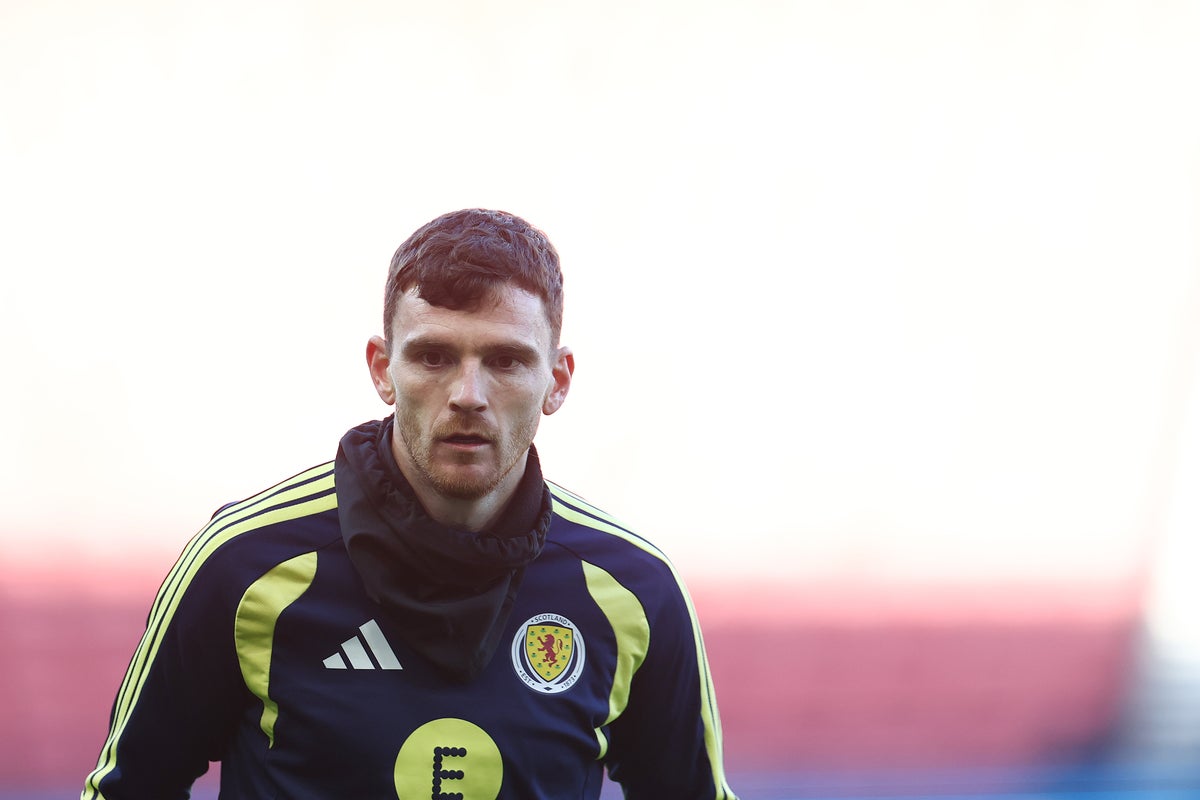
It was a burst from the left wing that would be seen time and time again. Andy Robertson’s first goal for Scotland came on just his fourth appearance for his country, at 20 years old and only a few months after completing a £2.85m move from Dundee United to Hull City. The wider importance of the goal was ultimately forgotten, a late consolation against England in a 3-1 defeat at Celtic Park. But for Robertson, with his wide-eyed excitement and the determination to carry his run forward, it was the moment that set the tone for what was to follow.
Twelve years later, Robertson will join the great Sir Kenny Dalglish on 102 caps when he leads Scotland out against North Macedonia at Hampden. In a few more days, he will pass his hero and legend for both his childhood club, Celtic, and adopted one, Liverpool, to stand alone as Scotland men’s record appearance holder on 103. It is only in keeping with Robertson’s humility that he is the first to insist Dalglish remains Scotland’s greatest player; it is only in keeping with Dalglish’s typical wry humour that he reminds Robertson that his own tally of international appearances would be much higher had competitions like the Nations League been around in his day.
“It’s not really about me,” Robertson said ahead of taking the record. "It’s about him [Dalglish] in my opinion. For how long the record stood, for what he achieved in his career, for the person he is.”
But Hampden will celebrate Robertson, too. What is not up for debate is the scale of achievement and the remarkable nature of his journey. His story is well known yet will be retold many times this week: how a boy released by Celtic for being too small and who worked in the Hampden ticket office while playing part-time with Queen’s Park would become one of the world’s best left-backs and a Champions League and Premier League winner.
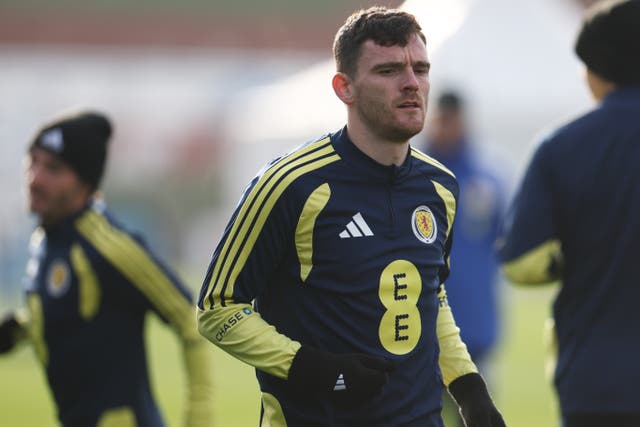
Andy Robertson will draw level with Kenny Dalglish as Scotland's most capped player (Getty)
With Scotland, part of Robertson’s legacy is formed by qualifying for three major tournaments in five years, when the Tartan Army had not previously been on the big stage since 1998. Robertson was the leader on each campaign under Steve Clarke, from the penalties against Serbia to reach Euro 2020 to beating Spain and Norway to deservedly make Euro 2024. Then, in the delirium that was Scotland’s win over Denmark to qualify for the World Cup, it was Robertson who provided another moment of inspiration when he poignantly remembered his late friend Diogo Jota and the promise they had made to each other while watching the 2022 World Cup four years before.
Robertson has led his nation with dignity and class and if insists that Dalglish remains the King, the counter is to suggest that he stands, by some way, as Scotland’s greatest captain. He is set to wear the armband for the 80th and 81st time this week, putting him well clear of George Young, on 48, and Billie Bremner, on 39. Robertson took on the armband just four years after his senior debut, at the age of 24. Should he continue through to Euro 2028 and Scotland, as co-hosts, ensure their place, he may lead the Tartan Army at a fourth major tournament and mark a 10-year stint as captain. The history of the Scotland men’s national team is around 150 years old, yet he would hold another record.
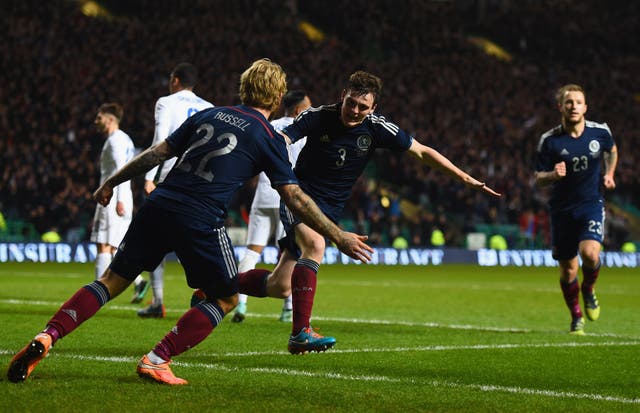
Andy Robertson of Scotland celebrates scoring against England for his first international goal in 2014 (Getty Images)
Euro 2028 could be important in another respect. For although Scotland have enjoyed a golden period in terms of qualifying for major tournaments, they have underperformed in all of them and have yet to escape the group stage. The missing piece for this generation of players, which they could hold above those of the past, remains out of reach. For Robertson, he will not need reminding that Clarke’s considerable achievements as head coach come with the reality that Scotland failed to perform on the big stage, with the 1-0 win over Haiti in Boston in June their only victory in nine attempts at major tournaments. Now under a fourth head coach with Scotland, in Sebastien Pocognoli, there is still time to amend that.
It has not helped Robertson that during his time as Scotland captain two of the other home nations have been led by talismanic captains in Harry Kane and Gareth Bale, players who brought attacking inspiration and who could change a game in the flick of a switch. Robertson’s rise and formidable peak at Liverpool came when he was part of a machine, where the driving runs of the flying left-back fitted in with the movement of the front three and the organisation of the midfield. At Scotland, Robertson has provided plenty of assists and thrust, but, unlike his old team-mate Trent Alexander-Arnold, he is not the sort to orchestrate from full-back.
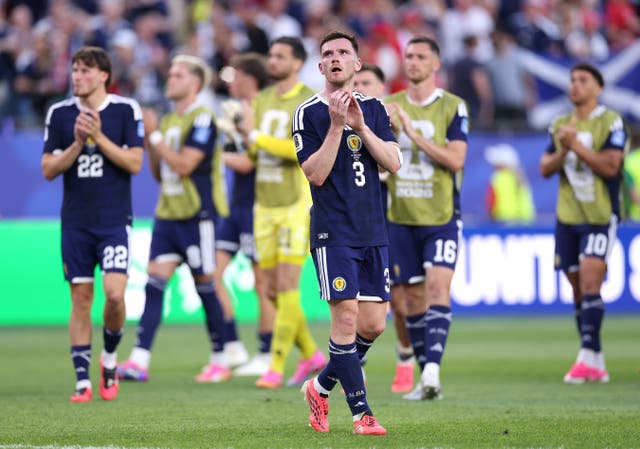
Andy Robertson applauds the Tartan Army in Foxborough during the 2026 World Cup (Getty)
Robertson has, however, worked to squeeze everything he could possibly get from his career. Perhaps it was overcoming rejection that made him take nothing for granted, but Robertson has made history by turning the ordinary into extraordinary: by showing up camp after camp, for never letting his country down. There is the work-ethic, the commitment, the desire to push for every cap as if it is his last. There are the personal touches, too, forming a spirit and a togetherness that took a Scotland squad further than they had done in a generation. But above all, Robertson continued to play the game in the way he always vowed to: as if he was a fan who had just come down from the stands. And in his relentless pursuit, he has made a nation proud along the way.