
'/%3e%3cdefs%3e%3clinearGradient%20id='prefix__paint0_linear_4737_37157'%20x1='3.018'%20y1='23.6'%20x2='44.925'%20y2='24.977'%20gradientUnits='userSpaceOnUse'%3e%3cstop%20stop-color='%231CB7FF'/%3e%3cstop%20offset='.502'%20stop-color='%232FF58B'/%3e%3c/linearGradient%3e%3c/defs%3e%3c/svg%3e)


From wonder saves to an iron will amid injury setbacks, why Craig Gordon may just be the greatest Scottish goalkeeper of all time
Jul 16 2026 18:47 · By Stephen Halliday · 6 Reads


The fairytale ending which he craved — and would certainly have deserved — ultimately eluded Craig Gordon.
Yet as the 43-year-old finally calls time on his playing days, he can reflect proudly on a career which could have come straight off the pages of a Boy’s Own comic book adventure.
Gordon did achieve his ambition of going to a World Cup with Scotland but had to settle for a non-participant’s role in the USA this summer as Angus Gunn was preferred in goal by Steve Clarke.
Yet as Gordon retires 25 years after making his senior professional debut, he can be assured that his name will always be included in any debate over who was the greatest Scottish goalkeeper of all time.
It is not only his remarkable longevity and the 84 caps he earned with his country which place Gordon firmly in the pantheon of the finest shot stoppers ever to wear that international jersey.
It is not simply his unquestionable talent, the awareness and reactions which saw him continue to make breathtaking saves right into his final season.
Craig Gordon celebrates as Scotland score against France at Hampden in 2006
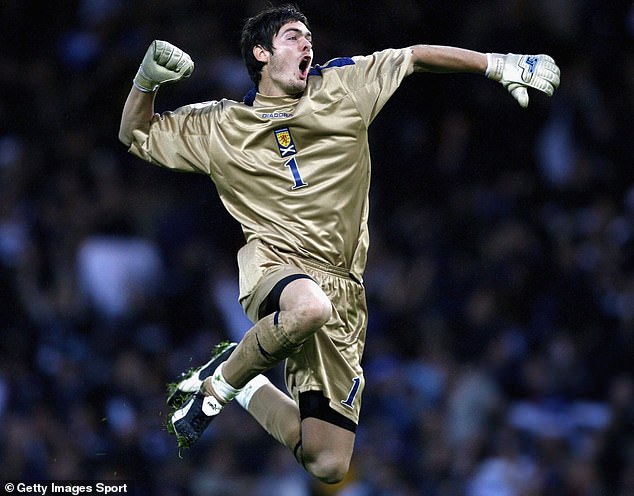
Perhaps Gordon’s greatest quality, aside from an unwavering self-belief, was his resilience in coping with and overcoming serious injury issues which would have prompted most footballers to throw in the towel many years ago.
The most severe of them was the chronic knee problem which effectively ended his time at Sunderland in 2012 and saw him spend the next two years without a club while being advised by surgeons to retire.
Not for the first time, Gordon defied the odds to sign for Celtic in the summer of 2014 and embark on a successful six-year stint in the east end of Glasgow during which he collected 11 major winners’ medals.
On Christmas Eve in 2022, back at his first club Hearts and just a week shy of his 40th birthday, a double leg fracture in a collision with his former Scotland team-mate Steven Fletcher during a game against Dundee United cast fresh doubts over Gordon’s ability to extend his career.
Yet again, he confounded expectations and returned to first team action for the Gorgie club just over a year later.
Gordon still had one final Lazarus-like comeback in his locker, agreeing to undergo neck surgery in March this year which he knew carried a risk of long-term paralysis. It was a gamble he was prepared to take in order to book his place on the Scotland plane to the World Cup Finals.
If there is any lingering frustration on his part that he then had to sit on the bench and watch the games against Haiti, Morocco and Brazil, Gordon can take great satisfaction in that any regrets he has from his career are vastly outweighed by his accomplishments.
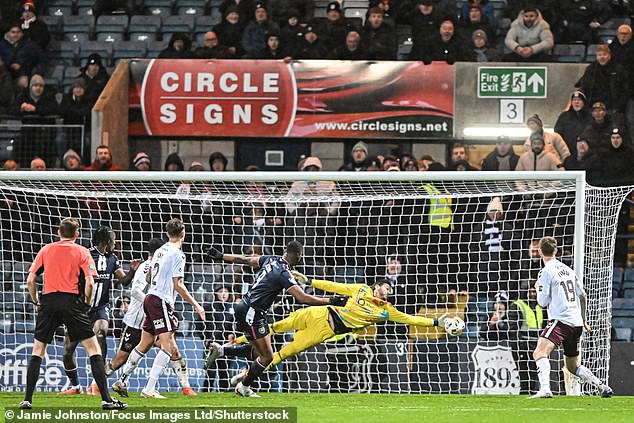
Gordon's save from Dundee striker Emile Acquah last year was one of the greatest ever seen
The 403 hardy souls who were at Station Park in Forfar on 8 September, 2001 would have paid scant attention to the 18-year-old who made his senior debut that day as he began a loan spell with Cowdenbeath.
Hearts, who had signed Gordon as a schoolboy, were already fully aware of his rich potential after he helped their under-18 squad win both the Scottish Youth Cup and SPL Youth League under coach John McGlynn.
Gordon made his first team debut for Hearts in 2002 and by the 2003-04 season had established himself as first choice goalkeeper with the club he had supported as a boy. At the end of that campaign, he also made his senior debut for Scotland in a friendly against Trinidad and Tobago.
As his reputation grew, Gordon found himself as a key player in one of the most dramatic and tumultuous periods in Hearts’ history as they were taken over by Russian-born Lithuanian businessman Vladimir Romanov.
Gordon’s brilliance was a major factor in their ultimately unsuccessful SPL title challenge in 2005-06, with a Scottish Cup final triumph against Gretna bringing consolation and the first major silverware of his career. He was also crowned Player of the Year for the first time by the Scottish Football Writers’ Association.
The following season, as one of the ‘Riccarton Three’ alongside senior team-mates Steven Pressley and Paul Hartley who spoke out against Romanov’s increasingly eccentric and ruinous running of Hearts, it became clear Gordon needed a fresh challenge.
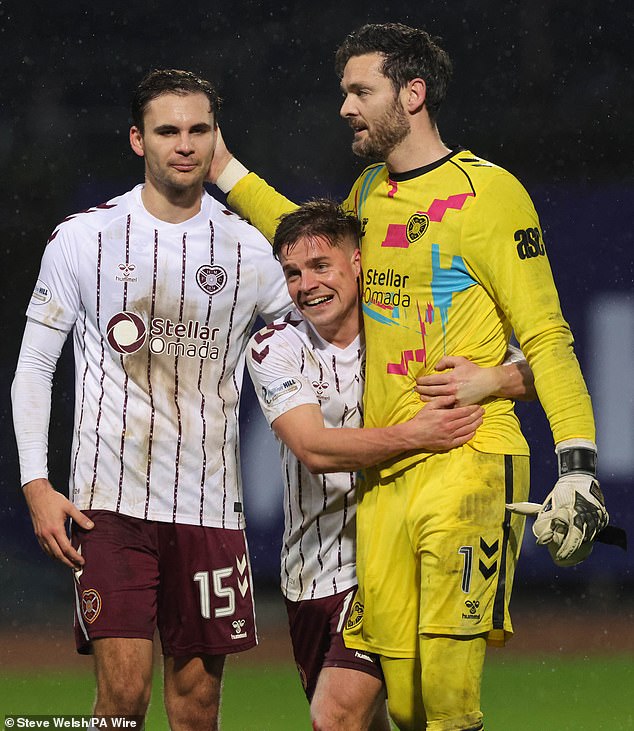
Gordon is hailed by his Hearts team-mates after doing his bit in their title charge last season
It came in the form of a move to Sunderland in 2007 for what was then a British record fee for a goalkeeper of £9million.
While Gordon’s time at the Stadium of Light was punctuated by arm and knee injuries, he enjoyed periods of exceptional form which compared favourably with any of the elite goalkeepers operating in the top flight of English football at the time.
A gravity-defying reflex save to keep out a close range shot from Zat Knight of Bolton in 2010 was voted as the greatest in the 20-year history of the Premier League in a poll two years later.
During the two-year hiatus prompted by the knee injury which ended his time at Sunderland, Gordon did some part-time coaching work at Dumbarton while also undergoing rehab at Rangers’ training centre under the Ibrox club’s then physio Stevie Walker.
It was Rangers’ greatest rivals, however, who benefitted from Gordon’s eventual return to full fitness when he signed for Celtic in 2014.
He quickly proved that his lengthy lay-off had done nothing to dull his ability. Among several outstanding displays, the string of stunning saves he produced in a Europa League tie away to RB Salzburg in November 2014 earned him the admiration and respect of Celtic supporters.
Gordon recovered from serious injury to become a serial winner with Celtic
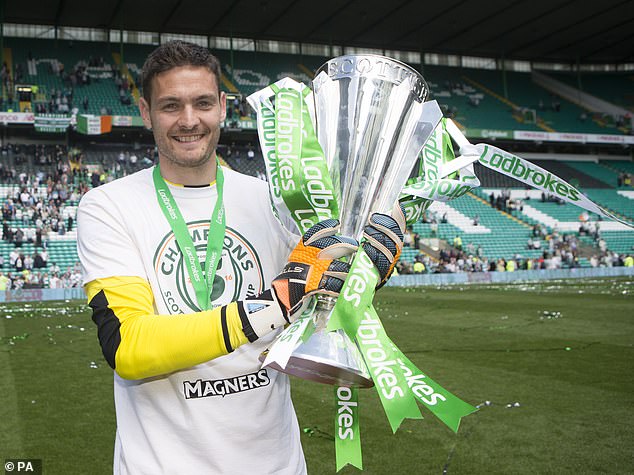
It was as if Gordon had never been away — in that first season at Celtic, he collected his first Premiership winners’ medal and was named Player of the Year for a second time by the SFWA.
When Ronny Deila was replaced as Celtic manager by Brendan Rodgers in 2016, Gordon’s place in the team came under threat. His distribution from the back with the ball at his feet was never his strongest asset, although also never as poor as some critics suggested.
Rodgers clearly had initial doubts about Gordon, signing Dutch goalkeeper Dorus de Vries who started the season as first choice.
By September, however, Gordon had reclaimed the jersey and ultimately won Rodgers over as he contributed significantly to the start of Celtic’s serial treble-winning era. In total, Gordon kept 116 clean sheets in 242 appearances for Celtic, a near 50 per cent ratio.
When Gordon lost his place in the side to Fraser Forster during the Covid-truncated 2019-20 season under Neil Lennon’s management, he opted to leave that summer and return to Hearts, who were then in the Championship.
Gordon helped them make an immediate return to the top flight and then inspired a third-place finish in 2021-22 when his form saw him become the first ever three-time winner of the SFWA Player of the Year award.
Despite not getting the chance of a World Cup farewell, Gordon can be very proud of his career
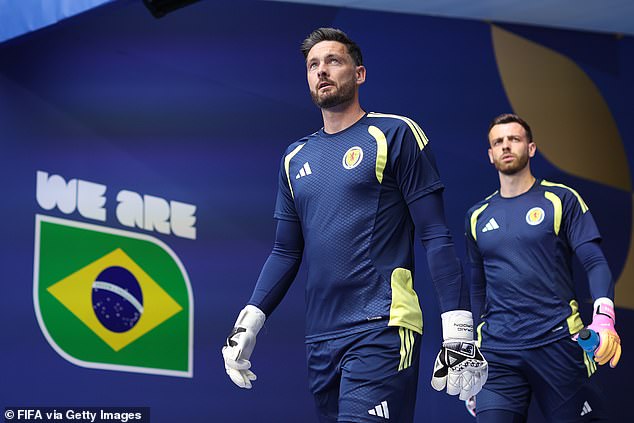
While time eventually caught up with Gordon, his light burned brightly right to the end — his mind-boggling 94th-minute save to deny Dundee striker Emile Acquah in a 1-0 win for Hearts at Dens Park in January this year will go down in folklore as one of the greatest ever witnessed in Scottish football.
As for Gordon’s place in that all-time ranking of Scottish goalkeepers? Cases can be made for legendary pre-war figures such as Jimmy Brownlie, John Thomson and Jerry Dawson, alongside Jimmy Cowan and Bill Brown from the early post-war period.
From the 1970s through to the 1990s, David Harvey, Alan Rough, Andy Goram and Jim Leighton all enjoyed distinguished periods as Scotland’s No 1. Two of Gordon’s own contemporaries throughout his international career, Allan McGregor and David Marshall, also excelled.
When it comes to compiling that ultimate list, however, Gordon’s name would not look out of place right at the top.