
'/%3e%3cdefs%3e%3clinearGradient%20id='prefix__paint0_linear_4737_37157'%20x1='3.018'%20y1='23.6'%20x2='44.925'%20y2='24.977'%20gradientUnits='userSpaceOnUse'%3e%3cstop%20stop-color='%231CB7FF'/%3e%3cstop%20offset='.502'%20stop-color='%232FF58B'/%3e%3c/linearGradient%3e%3c/defs%3e%3c/svg%3e)


How Gary Neville is missing the point over Man United's running stats, why Michael Carrick isn't worried about 'lack of effort', the way he's copying Sir Alex Ferguson and the numbers that tell the other side of the story
Sep 21 2026 18:51 · بواسطة Nathan Salt · 6 عدد المشاهدات


The truth is, Michael Carrick made his feelings clear on running statistics long before fronting up at Fulham on Sunday night.
Where others such as Gary Neville are apoplectic with rage at the lethargy ('lack of effort' as Neville put it) with which Manchester United are playing – he described a spell in the first half as the worst 15 minutes he had seen from United in 45 years – Carrick is not.
He didn’t focus on running stats as a player, and certainly doesn’t now.
‘David [Moyes] was right that in terms of “distance covered” we weren’t one of the top sides in the Premier League,’ Carrick wrote in his 2018 book Between the Lines, recalling one of Moyes’ first meetings with the squad upon succeeding Sir Alex Ferguson, in which he vowed to have them running more.
‘But if you look back over the years, all the good years, teams might come to Old Trafford and run a lot more than us, but quite often we ended up winning 2-0, 3-0 or 4-0. Under Sir Alex, we were very efficient with the ball.’
At Middlesbrough, though, ask their supporters what the biggest weakness of Carrick’s Boro side was and they will unanimously cite the lack of intensity in the press and the defensive issues that arose because of it.
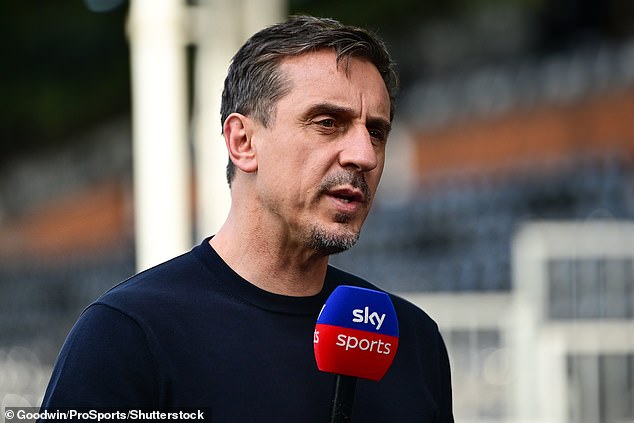
Gary Neville was fuming at United's lack of effort in their 1-1 draw with Fulham at the weekend
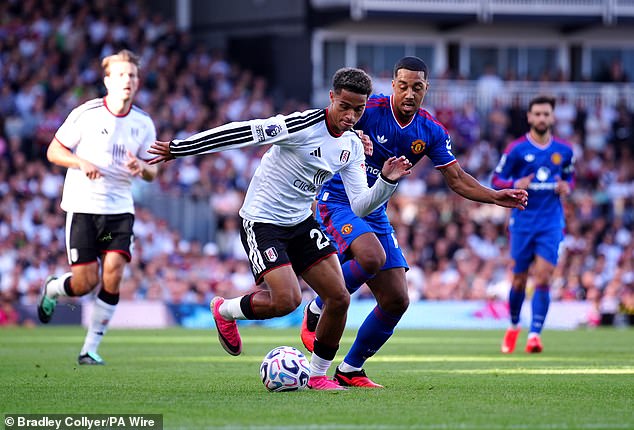
Then he had Jonny Howson and Hayden Hackney as a midfield pair, now it’s Kobbie Mainoo and Youri Tielemans. On the ball both pairs are brilliant. Without it, the shortcomings are strikingly similar.
The thing is, win games and nobody talks about running stats. Win the game and the number of minutes spent at high intensity is likely airbrushed from the conversation. Win the game and the pros and cons of your system and your beliefs are saved for another day.
But United aren’t winning. They lost at Hull City in abject fashion. They lost to the 10 men of Manchester City. They drew at Everton and they drew at Fulham.
Even with a 5-2 win against Ipswich Town, this is United’s worst start to a Premier League season since 2013-14. Fail to beat Tottenham Hotspur and Carrick will officially have masterminded United’s worst ever start to a Premier League campaign.
Fundamentally there is a chasm between a fanbase that want to see intensity, a buzzword that has stalked United for years, and effort, versus a manager that believes distance covered, sprints made and sheer physical output is not the only way to win a football match.
So, you end up here, United heading into the international break dead last in sprints made, dead last in distance covered at high intensity, dead last in the amount of time spent at high intensity, dead last in the amount of time sprinting, and with only three teams spending more time walking without the ball than United do. And with a manager who rejects all criticism about those metrics.
‘I didn't think we did [look passive]. Did you think we were passive? Football is a difficult game,’ Carrick said as the inquest into the drab Fulham draw began with haste.
‘We controlled a lot of the first half and we played a lot of good football today. There are going to be spells when you don't have it go your own way.
Youri Tielemans is brilliant on the ball for United but without it his shortcomings are there for all to see
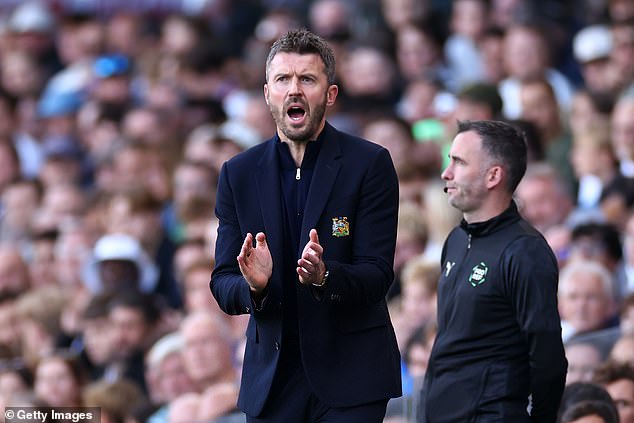
Michael Carrick refuses to get hung up on Manchester United's running statistics
'To expect total dominance for the whole game, I don't think anyone gets that in this league.’
Passivity has been a trigger word for Carrick all season long. He rejected that assessment at Hull, and did so again at Everton and now at Fulham. Where he sees control and patience, others see laziness and a lack of ideas.
To indulge Carrick, let’s look beyond the surface numbers that went viral soon after the final whistle. What we know to be true is that United ran 6.5 kilometres less than Fulham on the day, the second biggest disparity between teams when 11 v 11 so far this season.
What we also know to be true is that Fulham started their passing sequences – when moves in attack begin – 36.9 metres from Senne Lammens’ goal, on average. In this latest round of matches, no side started closer to their opponents' goal than Fulham did.
We also know that Bryan Mbeumo was the only United player to sprint more than 305 yards against Fulham, with 408.4. Bruno Fernandes, for example, was recorded to have sprinted just 35.2 yards in total. Kobbie Mainoo clocked in at 71.5 yards.
It can also be pointed out that of the top 70 players in the league this season for number of sprints made, only two play for United in Mbeumo and Marcus Rashford. Brentford and Bournemouth combine for 11 players in this category.
But then you need to look at the numbers Carrick cares about. The numbers he is focusing on. Numbers that show United had 29 shots against Fulham, taking their overall total to 113, ranking first of all 20 Premier League sides.
Or the fact that Carrick’s side rank third in the league for expected goals (xG), with 9.9. Or the fact they rank first in the league for touches in the opposition’s box (182) and have allowed the fewest touches in their own penalty area (92). They are fourth in the league for possession and second in the league for most accurate passes per match.
All of the above statistics point to the conclusion that this so-called 'lethargic' United has to be, in part, by design.
No, Carrick will not be explicitly telling players not to run and not to work hard, no manager would. Yet he fundamentally disagrees that those metrics represent the keys to success.
Liverpool, for example, are the side which cover the least ground in the league under Andoni Iraola, yet they also top the sprint charts. It doesn’t have to be one or the other, that’s the gripe among United fans.
Carrick wants to evolve into a possession-focused, pass-dominant side that can manage matches at their own pace, strangling the life out of teams through control. His own style as a player, going back to his dismissal of Moyes in his book, has unquestionably influenced his ideology.
‘Naturally, we all see the game for certain things,' Carrick explained to reporters at a sit-down during pre-season. 'We enjoy seeing different things and your eye naturally takes you to different parts of the game. We can all watch the game and see something a little bit different.
‘Just being a midfielder, that's how I've seen the game. In some ways, it helps because you kind of connected to all parts of the team over time.
‘I'm not saying you have to be a midfielder to be a good coach, but I think it's just how my reference points are in some ways and what I feel's worked over the years, what kind of football I think the supporters want to see as well, and hopefully that fits together.’
Supporters want to see wins but they crucially want to see effort and application upon the eye test, regardless of the more detailed data.
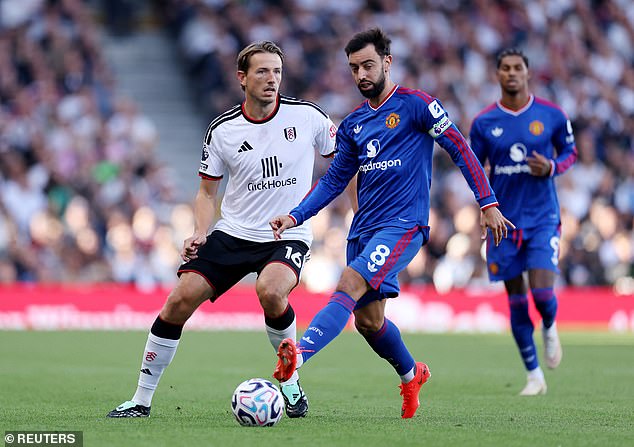
Bruno Fernandes sprinted for just 35.2 yards at Craven Cottage on Sunday
Calvin Bassey celebrates United's own goal that put Fulham ahead
‘It's about intensity, body language, physicality,' Ralf Rangnick explained in December 2021. 'This was always the case. If you want to keep control of a game like this you need to be physically present, and this wasn't the case in all positions.'
‘I think the main problem, that we did before in games much better, is intensity,' Erik ten Hag mused in October 2022. 'We have to bring the intensity in every game on the pitch. That was the big difference between City and us.'
‘Most important is the intensity,' Ruben Amorim bluntly pointed out in December last year. 'You can feel it right away, when we start the game. We can feel when we are at the top level in intensity and when we are not, and you cannot win games in this way.’
All that sounds and feels painfully familiar.
Fans believe intensity holds the key, as does Matheus Cunha, who spoke passionately about it after the Fulham game. Three of Carrick’s predecessors believe success is built on the foundation of intensity, while director of football Jason Wilcox previously talked up the ‘intensity’ in training sessions day in, day out.
But if you have a head coach whose philosophy goes against everything the Premier League has become in terms of blood and thunder football played in fast forward, is a three-week break really going to deliver the change required? Doubtful.
Carrick is determined to do it his way and that’s why United are never going to be the Duracell bunnies of the Premier League under his watch.
This feels like a hill that Carrick is very much willing to die on.