


Inside the crime epidemic striking fear into Premier League stars: Terrified players paying 'protection money' and buying £20,000 guard dogs, WAGs targeted in violent carjackings and the fall of the crime family who targeted Alexander Isak
Nov 20 2026 13:18 · By Ian Herbert · 90 Reads


The man parked up in a nondescript green Ford Fiesta cut an incongruous sight in the affluent residential neighbourhood of Casal Palocco, in south-west Rome, but no one paid him much notice. He made no eye contact and at no stage stepped from the car.
It was only after the street’s famous resident, AS Roma’s Belgian midfielder Radja Nainggolan, had his home burgled and an extraordinary £400,000 worth of possessions stolen that the player’s then wife, Claudia, six months pregnant at that time in April 2016, recalled the Eastern European-looking man in the battered vehicle up their street.
He was Vlada Djuric, a 50-year-old Macedonian of Romani descent and part of the wider Nikolov family, including his wife Zora Jovanovic, their two sons and daughter, whose highly organised thefts from the homes of top footballers would continue for more than a decade, with imprisonment deemed only a minor setback.
While the Nainggolans were blithely unaware of the criminal family’s lookout man – they’d gone to visit friends nearby for a couple of hours and hadn't even bothered to activate the burglar alarm – the assailants were primed to seize the chance.
The two sons, Valentino and Giacomo, mounted the villa’s perimeter wall, opening one door with a magnetic card and jimmying another with a screwdriver, and proceeded undisturbed through the house in 27 minutes, throwing the proceeds of their burglary into a bag as they went.
There were 15 watches (Rolex, Patek Philippe and others) valued at £250,000 and 20 pieces of jewellery, including a diamond worth £25,000. Security cameras on a landing and in an internal room filmed them but such was their confidence, they only partially covered their faces.
Former Roma midfielder Radja Nainggolan and his then wife Claudia, who was six months pregnant, were the targets of a burglary in 2016 (Source: Instagram/Claudia_lai_82)

Nainggolan had an extraordinary £400,000 worth of possessions taken, including 15 watches
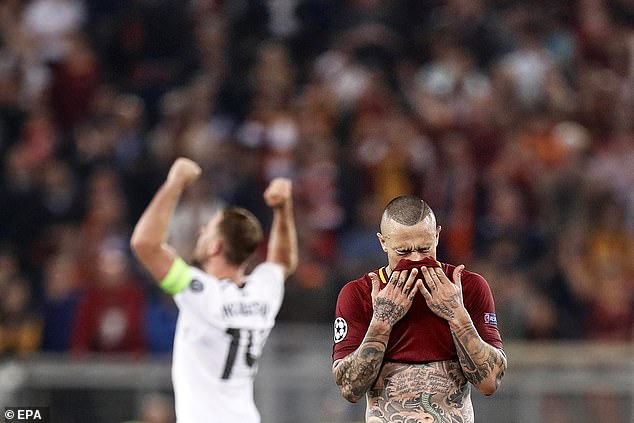
It was old-fashioned detective work from a local officer, Bruno Failla, which led police to a rambling home at Lurano, a small town six hours drive away in Lombardy, at which the Nikolovs would lavishly entertain other members of the Romani community.
The watches matched the descriptions of those stolen from the Nainggolans, though it was a necklace with a Roma logo, and the pair of red shoes with Nainggolan's initials, which really gave the game away.
‘I ask again for vigilance and watchfulness, please,’ Failla said at the time, because this was the fourth time that footballers' properties in Casal Palocco had been targeted in the space of five years. But the challenge of placing footballers in a state of constant vigilance became clear fully seven years on, when another Nainggolan residence, in Antwerp, Belgium, was burgled while his relatives held a party there.
‘It is one of the most complicated and consistently challenging parts of our security work,’ one former special forces soldier now providing security for footballers tells Daily Mail Sport. ‘It’s been a big sector of our work for years now, but the movements of these clients are so public and that’s irresistible to criminals. The wealth is very evident.’
One of the sons, Valentino, was jailed for two years in 2016 and other members of his family also did time, but once out, they all set their sights on the Premier League. In 2024, they arrived in the UK via a ferry to Dover from Calais, stopped off in London and made their way north, sleeping in a Ford motorhome and travelling to target homes in a Citroen C3.
A spree of attacks ensued from them on the homes of Alexander Isak, then a Newcastle player, Wolves’ Matheus Cunha (who has subsequently been burgled again while at Manchester United), Birmingham City’s Neil Etheridge and Leon Bailey, with Aston Villa at the time.
A number of Premier League clubs, including Liverpool, Everton and United, are known to have appointed their own security teams to provide an around-the-clock presence at the homes of players who are in squads playing away from home – rather than have that in the hands of a range of private operators.
Some of the top football TV analysts are known to have sought the same security cover outside their houses when away at games.
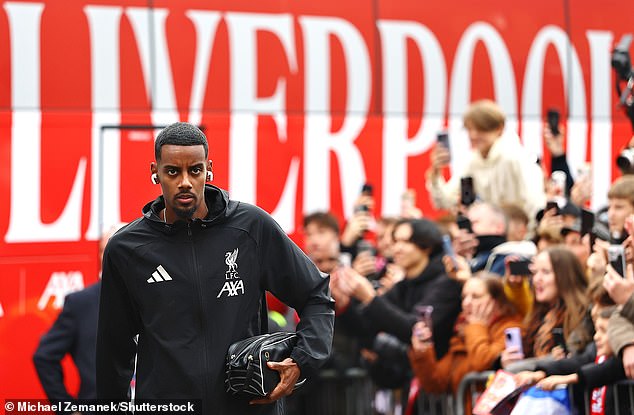
A number of Premier League clubs, including Liverpool, have appointed their own security teams to provide an around-the-clock presence at the homes of stars who are playing away
Three masked criminals managed to slip over Bruno Fernandes' security fence and into his home in Nether Alderley, Cheshire, last month and made off with jewellery
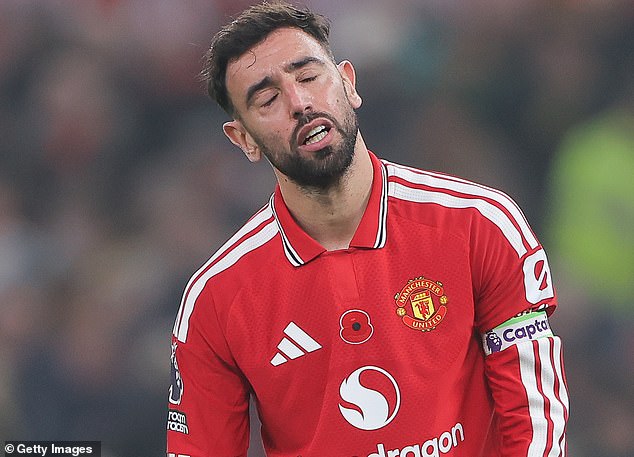
It didn’t work in the case of Manchester United’s Bruno Fernandes. Three masked criminals still managed to slip over the security fence into his home in Nether Alderley, Cheshire, last month and make off with jewellery.
It was one of the player’s neighbours who spotted them on their CCTV system and alerted police, who arrived five minutes after the burglars had left. Some in this security sector feel that it takes the private firms' former military and special services experience to cope with the criminal gangs’ level of sophistication.
Clubs using security staff in this way is a relatively recent development. In the days of security officers like United’s Ned Kelly, who wrote a book about his 14 years with the club, the job entailed ensuring the team were protected in public, or ferrying managers and new signings around.
Many clubs still leave it to players. ‘Player-liaison staff will recommend vetted security providers but it’s down to player personal choice for obvious reasons,’ says one player agent.
'That's not always been easy,' says a former Premier League player-liaison officer. 'The players have a huge entourage: so-called experts who want a seat at the table and think they know best. Of course, social media enhances the security problem.'
The house burglars’ modus operandi pales by comparison with some of violence displayed by others who prey on the footballer set. One footballer's wife in Cheshire was driving a top-of-the-range vehicle when a moped took up a position in front of her and slowed. In her rear-view mirror, she saw a second. The driver of the third then arrived at her side window, assessing what there was to steal.
On any given day, there could have been £200,000 worth of jewellery in the car, though she was wearing neither rings nor a watch on this occasion. The three drove off.
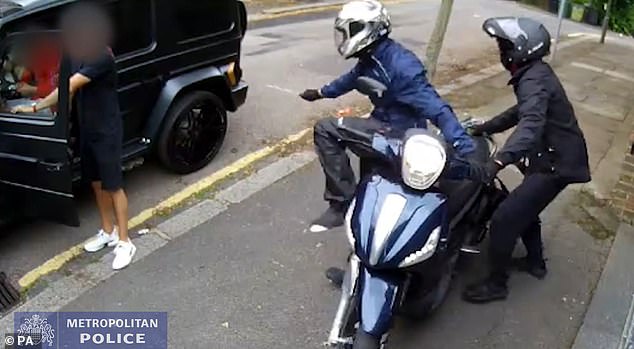
The episode had echoes of the attempted heist which saw Arsenal’s Mesut Ozil and Sead Kolasinac carjacked in broad daylight in north London, seven years ago.
Sead Kolasinac, then of Arsenal, thwarts an attempted carjacking in broad daylight in north London, seven years ago. Kolasinac was with his team-mate Mesut Ozil at the time
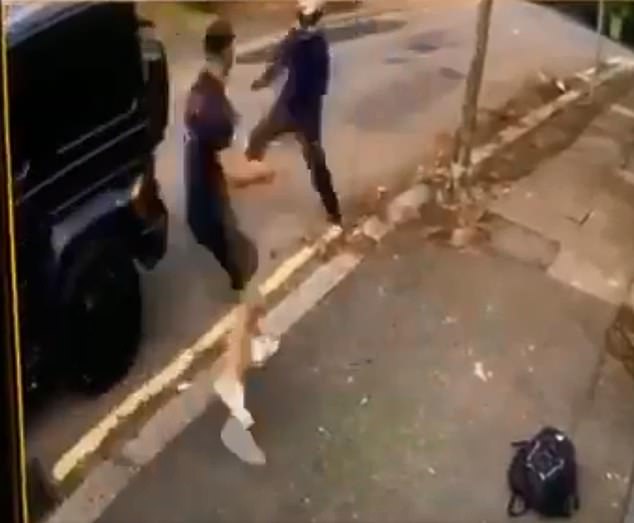
Attackers go for Kolasinac after his car was 'boxed in' when approaching traffic lights
Paul Hughes, managing director of Benchmark Security Group, a leading Manchester-based protection firm, employs former police and Royal security drivers to train his clients in the art of 'defensive driving'.
In a two-hour session, they learn how to avoid being 'boxed in' – as Ozil and Kolasinac were – when approaching traffic lights. Techniques include never taking up a position in the middle lane, avoiding the outside lane if there is a central barrier, and always maintaining sight of the tyres of the vehicle in front when you slow.
'If you can see the tyres, you will always have room to manoeuvre right or left of the car in front, at speed, without hitting it,' Hughes says.
His staff are often asked to escort clients in their fleet of vehicles, which includes two Land Rovers with blacked-out windows. The firm acquired a Darkfighter Dome – a night-vision camera which is mounted on to the roof of its security vehicles – allowing them to see would-be assailants in the dark. Escorted school runs are also part of the protection they offer.
A screen which dominates Benchmark's underground headquarters, at anonymous premises in Manchester, revealed the fortresses that players' houses have become, when I visited.
It showed live feeds from the gardens of mansions which are criss-crossed by infra-red beams. An alarm is triggered in the control room if anyone not approved through face-recognition software is picked up by up to 18 pan, tilt and zoom cameras at a property.
Loudspeakers, operated from the control room, warn off intruders. A team of security staff is never more than six minutes away. A patrol is on the scene of an alert, usually within 90 seconds.
A number of Manchester United players have invested in specialised security dogs from the Leicester-based firm Chaperone K9 at a cost of up to £20,000 each, though some sources suggest demand has receded as many players have young children. Security firms have their own dogs.
Benchmark are one of Britain's most trusted operators – industry-accredited, with former senior police officers on their staff. But this is also a world in which some unsavoury individuals are looking to extract gain.
Daily Mail Sport is aware that a number of current players have paid protection money to ensure they remain safe and are not venturing out socially without having done so. The ‘panic rooms’ some install in their homes, with security card access, are a place to hide valuables.
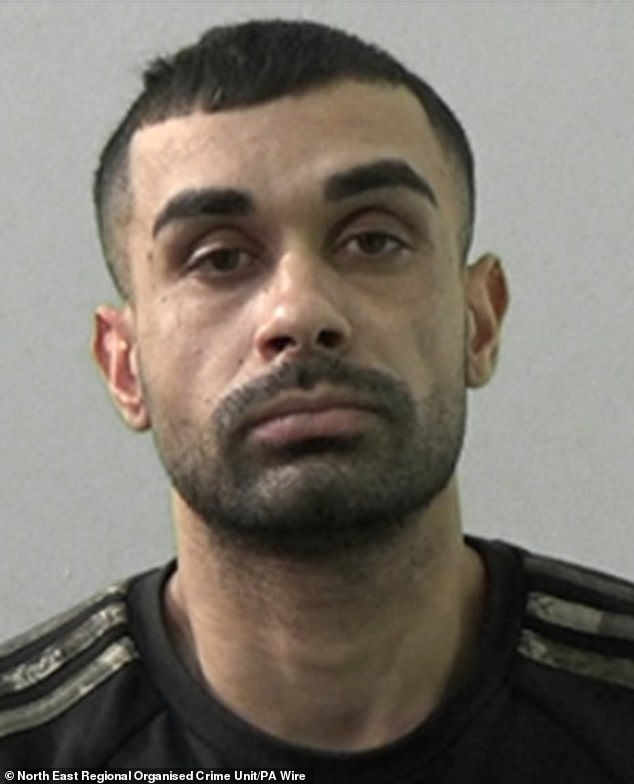
The family who preyed on footballers for a decade will be behind bars for some time. Valentino Nikolov (pictured) is serving an initial 10-year sentence, which has since been extended
Kolasinac fought off the carjackers. Everton's Duncan Ferguson put an assailant in hospital when he tried to burgle his home at Ormskirk, Lancashire, in January 2001. ‘I’m not a hard man off the pitch...unless you try to break into my house,’ he said recently.
But the assailants in the Ozil and Kolasinac attack were part of Eastern European gangs. 'The criminal demographic has changed,' one former senior detective tells me. 'We are now talking about gangs who lack the slightest compunction about taking a life.'
The Italian family who have preyed on footballers for a decade will be behind bars for some time. The Rome lookout man’s two sons were jailed for 10 years and eight years respectively at Newcastle Crown Court last year, for burglaries including the Isak attack – sentences since extended. Their mother is doing seven years.
That court case revealed how the family had moved on from the days of old cars, screwdrivers and shinning over walls in Rome – using Isak’s own vehicle as a battering ram to force entry to his Newcastle home.
'None of the property stolen from my home was ever recovered,’ Isak related. 'The attack left me with a sense of unease and a fear it could reoccur.'