
'/%3e%3cdefs%3e%3clinearGradient%20id='prefix__paint0_linear_4737_37157'%20x1='3.018'%20y1='23.6'%20x2='44.925'%20y2='24.977'%20gradientUnits='userSpaceOnUse'%3e%3cstop%20stop-color='%231CB7FF'/%3e%3cstop%20offset='.502'%20stop-color='%232FF58B'/%3e%3c/linearGradient%3e%3c/defs%3e%3c/svg%3e)


NBA Fantasy: Final top 150 for 2026-27 High Score leagues
Oct 17 2026 00:17 · By Alex Barutha, Kirien Sprecher, Nick Whalen – RotoWire.com · 4 Reads


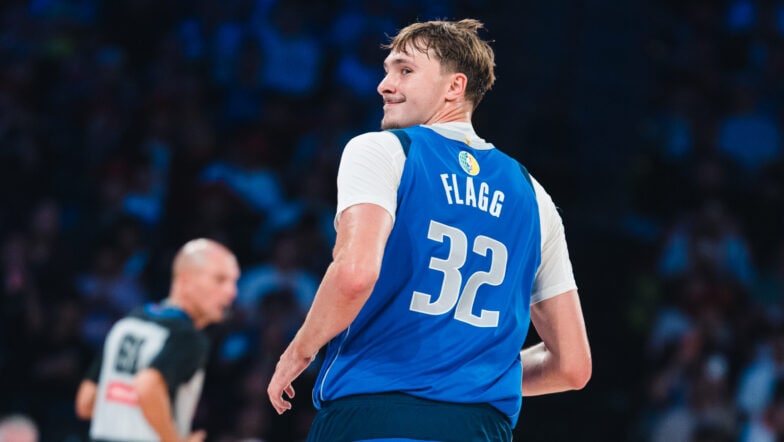
Cooper Flagg cracked the top 10 in RotoWire’s final edition of the top 150 High Score players this season.
Play Yahoo Fantasy High Score Today!
The NBA regular season starts on Tuesday, so it’s time to get those High Score drafts in! A quick reminder that this format rewards more for assists, takes away turnovers, and only counts the highest score from your starters each week. That brings up high-usage players with turnover concerns, and players who have games missed concerns tied to their names due to age or injury history.
Round 1
1.
Nikola Jokić
, Denver Nuggets
— 11 assists at two apiece, and nothing clawed back by turnovers. The largest weekly ceiling in the sport.
2.
Luka Dončić
, Los Angeles Lakers
— He owns the ball with LeBron gone, and his single biggest deduction, averaging over four turnovers a night, has been deleted in High Score.
3.
Giannis Antetokounmpo
, Miami Heat
— 30 points, 11 rebounds and 6 assists on huge minutes, with the turnovers and free throws both off the sheet.
4.
Victor Wembanyama
, San Antonio Spurs
— Everything that makes him elite still counts. However, he’s not a high-volume passer, which is a knock in High Score.
5.
Shai Gilgeous-Alexander
, Oklahoma City Thunder
— Scoring efficiency and free-throw accuracy don’t score, and his assist total is good rather than great. He’s a faller relative to category leagues and standard points formats.
6.
Cade Cunningham
, Detroit Pistons
— A Round 1 High Score winner: a heavy assist load worth double, and the turnovers that came with it cost nothing.
7.
Anthony Edwards
, Minnesota Timberwolves
— Scoring volume is the whole engine, so the assist dip that comes with LaMelo Ball running more offense costs him more here than it would elsewhere.
8.
Cooper Flagg
, Dallas Mavericks
— After a fantastic rookie season, Flagg should be able to take a step up in Year 2. His relative lack of 3-point shooting doesn’t cost you in High Score.
9.
Jalen Johnson
, Atlanta Hawks
— A 20/10/10 threat, and the games-played bet you’re making shrinks to almost nothing when one game carries the week.
10.
Jayson Tatum
, Boston Celtics
— Boston’s clear first option with Jaylen Brown gone, and early-season minutes management does much less damage when only his best game counts.
11.
Alperen Sengun
, Houston Rockets
— Career-high assists from the center spot with the turnovers that come attached wiped off the scoresheet. One of the best values in the format.
12.
Trae Young
, Washington Wizards
— 10 assists is 20 points before he scores, and the turnovers that always came with them are now free. A significant riser compared to standard points leagues.
Round 2
13.
Paolo Banchero
, Orlando Magic
— A high-usage forward with a high turnover rate that no longer costs him anything.
14.
Tyrese Maxey
, Philadelphia 76ers
— A real touch reduction is coming with Jaylen Brown and LeBron James. He can make up for it with efficiency in category formats, but not here.
15.
Josh Giddey
, Chicago Bulls
— A nightly triple-double threat as the hub of the offense, with the assists worth double and the turnovers free.
16.
Domantas Sabonis
, Sacramento Kings
— Rebounds and assists in bulk from center, with usage returning now that Westbrook and DeRozan are gone.
17.
Donovan Mitchell
, Cleveland Cavaliers
— Steady high-volume scoring, but Harden has the playmaking and the thin assist total costs more here.
18.
Jalen Brunson
, New York Knicks
— Usage leader on the league’s most stable offense, with a great points and assists combination.
19.
Scottie Barnes
, Toronto Raptors
— Kawhi Leonard trims his usage, but Barnes answers with rebounds, assists and defense.
20.
LaMelo Ball
— Huge per-game production, a huge turnover rate and spotty availability. This format forgives two of those three.
21.
Devin Booker
, Phoenix Suns
— Phoenix’s primary creator and highest-usage player. His declining 3-point rate doesn’t matter in High Score.
22.
Karl-Anthony Towns
— Almost nothing changed with the Knicks, so Towns’ role is secure. He’s a nightly 20-and-10 threat and showed improved playmaking in the postseason.
23.
Anthony Davis
— 20 games last season attached to a first-round per-game profile, which in a best-game format means the weeks he plays at all pay out nearly in full.
24.
Jamal Murray
— Clear second engine on a high-possession offense coming off a career-best campaign.
Round 3
25.
Amen Thompson
— Points, rebounds and assists in bulk, and the shooting splits that are his only flaw don’t exist in this format.
26.
Austin Reaves
— A high-volume secondary creator with a green light and neither an efficiency nor a turnover tax.
27.
Tyrese Haliburton
, Indiana Pacers
— An assist monster in an offense built entirely around him, and load management is close to a non-issue when a two-game week still produces one enormous score.
28.
James Harden
— A 20-and-10 threat with the assists worth double and the turnovers erased entirely. A riser in this format compared to other points formats.
29.
Kawhi Leonard
— One of the best players in the NBA when available, and you only need one big night out of him for it to pay off in this format.
30.
Bam Adebayo
— The assist volume is what separates him from the other bigs in this range, and he’s one of the safest 30-minute bets at the position.
31.
Kevin Durant
— Remains one of the league’s elite scorers, though his efficiency doesn’t give you a boost on its own in High Score, making him less valuable.
32.
Jaylen Brown
— Won’t have the volume of touches he saw last season, but is still a better High Score player than category-league one.
33.
Stephon Castle
— His two flaws are shooting efficiency and turnovers, and High Score charges for neither. One of the format’s best buys.
34.
Deni Avdija
, Portland Trail Blazers
— Scoring, rebounding and real playmaking from a forward. Morant and Lillard are the threat to the touches.
35.
Evan Mobley
— A quiet 18/10/4 as Cleveland’s third option. Steady rather than explosive.
36.
Stephen Curry
, Golden State Warriors
— 3-point-dependent value in a league with no 3-point category, at 38 years old.
Round 4
37.
Darius Garland
, Los Angeles Clippers
— Should have plenty of 20-and-10 nights as the Clippers’ primary playmaker.
38.
Julius Randle
, Brooklyn Nets
— Expected to lead Brooklyn in combined points, rebounds and assists, which makes him a buy in this format.
39.
Jalen Duren
— A nightly 20-and-10 threat whose game is still developing on both ends of the floor.
40.
Jalen Williams
— A healthy 20-point wing with balanced production, though he gains more in category formats.
41.
LeBron James
— The per-minute output is absurd and the assists are the most rewarded part of it, so a 28-minute role or a night off costs you far less than the draft price assumes.
42.
Cameron Boozer
, Memphis Grizzlies
— Immediate minutes and playmaking responsibility, and rookie mistakes don’t cost you here.
43.
Pascal Siakam
— A dependable well-rounded statline as Indiana’s clear No. 2 option.
44.
Brandon Miller
, Charlotte Hornets
— Charlotte’s most likely usage winner post-LaMelo, with adequate secondary stats.
45.
Trey Murphy III
, New Orleans Pelicans
— An efficient high-volume shooter with modest rebounds and assists, and Dejounte Murray’s return trims the usage.
46.
Matas Buzelis
— Led every Bull not named Giddey in counting stats in under 30 minutes.
47.
Derrick White
— Solid all-around, but the low turnover rate is no longer an edge and there are fewer shots with Jayson Tatum back and Paul George added.
48.
Dejounte Murray
— Points, assists and steals in bulk when right, though it remains unclear exactly how much his minutes and usage will be pushed.
Round 5
49.
Tyler Herro
, Milwaukee Bucks
— The first true lead-playmaking role of his career, and the injury history that always capped him is much cheaper to carry here.
50.
Kyrie Irving
— The clean efficiency and league-best turnover rate that make him a standout elsewhere are worth nothing here.
51.
Jaren Jackson Jr.
, Utah Jazz
— Utah’s crowded depth chart is the ceiling problem.
52.
Donovan Clingan
— Averaged a double-double in 27 minutes. The frontcourt is his to claim.
53.
Michael Porter Jr.
— Punished by High Score settings that don’t inherently reward efficiency and 3-point volume.
54.
Keyonte George
— All-Star-level production in a limited sample, but Darryn Peterson, Jaren Jackson and Lauri Markkanen all need touches.
55.
Zion Williamson
— A volume scorer with rebounds and assists chipped in, and the availability discount that defines his price mostly evaporates here.
56.
Chet Holmgren
— His 3-and-D profile as a big man isn’t rewarded here like it is in category formats.
57.
Franz Wagner
— A balanced offensive line that’s secure behind Banchero, and two injury-shortened seasons aren’t as scary in High Score.
58.
Lauri Markkanen
— Scoring and rebounding with very little playmaking, on a roster that just added mouths to feed.
59.
Joel Embiid
— An elite producer when he plays, and this is the only format where a 40-game season is close to fine. Draft the upside swing — the rules absorb it.
60.
Ryan Rollins
— Coming off a breakout campaign, but Milwaukee’s backcourt logjam makes his role less clear than managers would like it to be.
Round 6
61.
Payton Pritchard
— 3-point-driven value facing a clear step back in volume.
62.
Walker Kessler
— Rebounds and dunks off Luka Dončić passes with blocks. There should be plenty of big nights.
63.
Ivica Zubac
— Bounce-back candidate with Haliburton feeding him easy interior looks.
64.
Paul George
— 56 or fewer games in six of seven seasons is a far smaller problem here than his price suggests.
65.
Ja Morant
— Elite per-game scoring and assists, and a high turnover rate. High Score waves off one of the two.
66.
De’Aaron Fox
— Castle and Harper ate into the usage, but a healthy Fox is still a 22-and-6 guard.
67.
Nickeil Alexander-Walker
— A 3-and-D profile with little volume to accumulate.
68.
Desmond Bane
— Safe as Orlando’s No. 3 option, thin outside of scoring and some light supplementary stats.
69.
Dyson Daniels
— A low-usage wing with a well-rounded line and little playmaking volume to lean on.
70.
AJ Dybantsa
— The self-creation translates directly and the shaky jumper costs nothing. Usage competition with Young and Davis is the catch.
71.
Dylan Harper
— A second-year jump looks likely. San Antonio’s backcourt logjam is the obstacle.
72.
Zach Edey
— Excellent per-minute rebounding and scoring. Some managers are concerned about recurring ankle injuries, but that matters less here.
Round 7
73.
Damian Lillard
— Even a diminished Lillard produces points and assists at volume, and a year off an Achilles is a much smaller weekly problem than a seasonal one.
74.
Onyeka Okongwu
— A double-double baseline on 32 minutes a night.
75.
Kon Knueppel
— The upside is a 20-point scorer with more assists. The base case is efficient shooting, which scores nothing extra in High Score. However, he’s starting the season with a hamstring injury.
76.
Jalen Green
— He scores in bursts without much else, and bursts are precisely what gets counted.
77.
Darius Acuff Jr.
— A rookie starting point guard means high assists and high turnovers, and only one of those appears on the scoresheet.
78.
Immanuel Quickley
— 3-pointers and free-throw shooting are the value, and Toronto’s roster is crowded. He doesn’t pay off here compared to category formats.
79.
Kel’el Ware
— He just needs the minutes, and a rebuilding Milwaukee will probably supply them.
80.
Day’Ron Sharpe
— Elite rebounding rate and expanding offensive game. The per-minute production has always been there, and now he’s expected to start.
81.
Ausar Thompson
— Rebounding, steals and transition scoring, with poor shooting that costs him almost nothing. The biggest hurdle is getting to 30 minutes.
82.
Caleb Wilson
— A starting rookie on a team with minutes to hand out, and neither his efficiency nor his turnovers will be held against him. Defensive upside drives value.
83.
Cedric Coward
— Sophomore breakout candidate with more minutes coming on a young roster.
84.
OG Anunoby
— A secure role, though his 3-and-D profile doesn’t provide as much fantasy potential in High Score.
Round 8
85.
Ty Jerome
— Career-high per-game production in 15 healthy games, and a format that only counts the healthy weeks is the right home for that bet.
86.
Derik Queen
— 81 games as a rookie with a complete game built for fantasy basketball. Minutes and his role are question marks, but in High Score, the upside drives value.
87.
Mikal Bridges
— The most durable player in basketball, which is worth real money over 82 games of accumulation, but less when only his pop performances count.
88.
Naz Reid
— Past 30 minutes for the first time, with scoring, rebounding and a bit of playmaking.
89.
Coby White
— Now the unambiguous starting point guard but is dealing with a calf strain to start the year, the same one that hampered his production last season.
90.
VJ Edgecombe
— Minutes are secure, but a sophomore leap in touches isn’t.
91.
Miles Bridges
— Modest role, secure minutes, third in line behind Booker and Green.
92.
CJ McCollum
— Steady, defined role. Atlanta’s No. 2 option behind Jalen Johnson.
93.
Darryn Peterson
— A promising rookie shooting guard, though he’ll have to fight for touches in a revamped Jazz offense.
94.
Jaden McDaniels
— An improving self-creator whose looks should get easier with LaMelo running the offense.
95.
Davion Mitchell
— The tiny turnover rate that carried his case is worth nothing in High Score; what’s left is assists and a safe role.
96.
Josh Hart
— Rebounds and assists from a wing is a good shape, but the minutes dipped and New York’s rotation is set.
Round 9
97.
Rudy Gobert
— A clean bill of health despite his age and a walking double-double.
98.
RJ Barrett
— A nightly 20 points with some supplementary stats, making him a solid pick in points leagues.
99.
Jaime Jaquez Jr.
— Inside track on forward minutes in a wide-open rotation.
100.
Alex Sarr
— Still a starter, but Davis and Dybantsa reshaped the roster around him.
101.
Egor Dëmin
— Fourth in line behind Mikel Brown Jr., Randle and Porter, though should still have the opportunity for some big performances.
102.
Yaxel Lendeborg
— Speculative, but there’s a starting job available.
103.
Zach LaVine
— Heavy usage on a rebuilding team, and the 108 missed games in three seasons scare drafters more than they should in this format.
104.
Jarrett Allen
— Reliable floor, limited ceiling, eroding minutes. A poor fit for a peaks format.
105.
John Collins
— More minutes and touches replacing Tobias Harris than he had with the Clippers.
106.
Nic Claxton
— Rebounds and lobs from Giddey, on a team that acquired him specifically to play him.
107.
Ayo Dosunmu
— Should approach 30 minutes every game, and provides a well-rounded stat profile.
108.
Anthony Black
— With Orlando healthy, the minutes and touches aren’t obviously there.
Round 10
109.
Collin Sexton
— Sexton seems in line to play a sixth-man role for the Lakers, and he’s proven to be a microwave scorer.
110.
Kyshawn George
— Real Year 2 improvement into a much busier roster.
111.
Andrew Wiggins
— Third scoring option behind Antetokounmpo and Adebayo.
112.
Quentin Grimes
— A release valve for Dončić and Reaves, competing for the third-option role.
113.
DeMar DeRozan
— Could approach 30 minutes as a sixth man for Denver with upside for scoring outbursts and solid complementary stats.
114.
Ajay Mitchell
— Kia Sixth Man of the Year candidate with starter upside after Oklahoma City’s wing exodus.
115.
Norman Powell
— Two straight 20-point seasons and almost nothing else on the sheet.
116.
Mikel Brown Jr.
— A rookie starting point guard on a bad team will pile up assists, and nobody is charging him for the turnovers.
117.
Brandin Podziemski
— Rebounds and assists from a guard make him more useful than his scoring average suggests.
118.
Jeremiah Fears
— Very high usage in his minutes, though his role isn’t clear cut.
119.
Jalen Suggs
— The health question matters less in this format, though so does his 3-and-D profile.
120.
Neemias Queta
— Double-double threat now sharing the position with Mitchell Robinson.
Round 11
121.
Jakob Poeltl
— Field-goal percentage was his standout stat last season, and it’s worth nothing here.
122.
Kevin Porter Jr.
— Career-best numbers in 38 games, but Milwaukee added Herro and Burries, making Porter’s role murky.
123.
Isaiah Hartenstein
— Rebounds, assists and efficient interior scoring. Minutes and his role are capped.
124.
Fred VanVleet
— The assist volume drives his upside, though he probably won’t have as big of a role compared to years past.
125.
Andrew Nembhard
— His 16.9 points and 7.7 assists with Haliburton out is a ceiling, not a baseline — but ceilings are what this format rewards.
126.
Myles Turner
— A rough first season in Milwaukee and an unsettled roster make him hard to trust, and his stats come out better in category formats.
127.
Rui Hachimura
— With Brandon Ingram out indefinitely due to injury, Hachimura becomes the Clippers’ second option.
128.
Christian Braun
— 30-plus minutes, but last season’s across-the-board regression makes him hard to project.
129.
Jabari Smith Jr.
— High floor, low ceiling, and few shots left behind Durant, Sengun, Thompson and VanVleet.
130.
Sandro Mamukelashvili
— Strong per-minute player with sixth-man upside behind a thin Lakers frontcourt.
131.
Keegan Murray
— 23 games last season, but improved health on a rebuilding squad means usage should be available.
132.
Jonathan Kuminga
— Kuminga found a home in Minnesota and is expected to start, giving him intriguing upside.
Round 12
133.
Collin Gillespie
— 3-point value that doesn’t translate, likely off the bench once Phoenix is healthy.
134.
Saddiq Bey
— A long line of players competing for the same possessions.
135.
Toumani Camara
— Minutes are the only real draw.
136.
Peyton Watson
— First clear path to a full-time starting job, though usage will be hard to come by.
137.
Aaron Gordon
— Safe role and good chemistry with Jokić and Murray, and the injuries don’t cost much here.
138.
Cameron Johnson
— His counting stats collapsed in Denver while the shooting held up, which is the wrong half to keep in High Score.
139.
Ace Bailey
— Rounded into form late in his rookie season, but his role on the re-tooled Jazz is far from obvious.
140.
Khaman Maluach
— A double-double with multiple blocks is the upside case with Mark Williams out.
141.
Collin Murray-Boyles
— Versatile production across the board, with an open question about minutes.
142.
Keaton Wagler
— Wagler may not start, but he has plenty of potential given the lack of high-usage players on the Clippers.
143.
Cason Wallace
— A thin offensive profile, though more minutes are expected, and Wallace can rack up steals in bunches.
144.
Jrue Holiday
— The all-around line is respectable, but the offensive workload is shrinking behind Morant and Lillard.
Round 13
145.
Devin Vassell
— Declining usage on a rising team with no 3-point bonus to fall back on.
146.
Reed Sheppard
— The path to minutes narrowed with Marcus Smart added and Fred VanVleet back.
147.
Draymond Green
— Green is out of his prime, but in a format that rewards assists, he’ll have some big fantasy-relevant performances.
148.
P.J. Washington
— Mid-teens scoring and a high rebounding rate, with a busy frontcourt as the downside risk.
149.
Tre Jones
— Jones has established himself as a great passer, and even coming off the bench, can have some big games.
150.
Brandon Ingram
— A 20/5/5 forward in the clear top two of his offense, but he’s dealing with a partially-torn Achilles and his timetable is unclear.