
'/%3e%3cdefs%3e%3clinearGradient%20id='prefix__paint0_linear_4737_37157'%20x1='3.018'%20y1='23.6'%20x2='44.925'%20y2='24.977'%20gradientUnits='userSpaceOnUse'%3e%3cstop%20stop-color='%231CB7FF'/%3e%3cstop%20offset='.502'%20stop-color='%232FF58B'/%3e%3c/linearGradient%3e%3c/defs%3e%3c/svg%3e)


NBA Fantasy: Forward preview - sleepers and breakouts
Oct 08 2026 21:19 · By Juan Carlos Blanco, RotoWire.com · 5 Reads


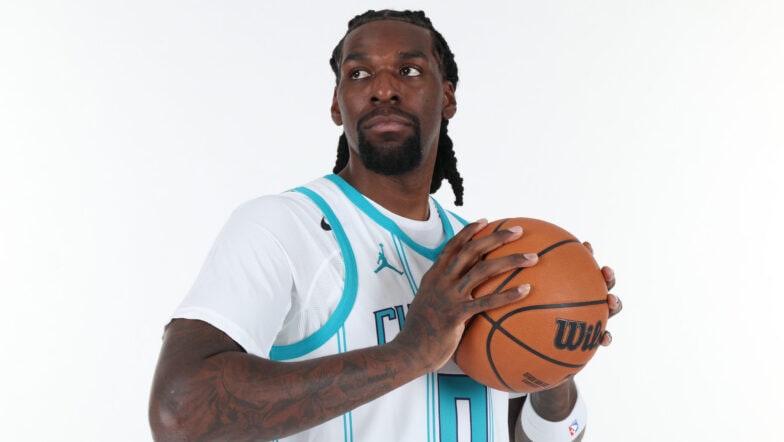
Charlotte Hornets newcomer Naz Reid is a potential breakout fantasy forward entering the 2026-27 NBA season.
Play Yahoo Fantasy High Score Today!
Forwards are a goldmine in fantasy basketball, and the 2026-27 season is loaded with versatile wings and bigs who can swing your league. Veteran stars Giannis Antetokounmpo, Jaylen Brown, LeBron James and Kawhi Leonard are in new uniforms, while rookies AJ Dybantsa, Cameron Boozer, Caleb Wilson and Yaxel Lendeborg could make an immediate fantasy impact.
Before your fantasy basketball draft, use this guide to find the top breakout forwards and under-the-radar sleepers. From Cooper Flagg’s second-year leap to value picks like Naz Reid and Jaime Jaquez Jr., here are the forwards to target.
5 Draft Strategies For Forwards
Prioritize versatile forwards early
Guards are often the flashy players who catch the eye early in drafts, but there are natural exceptions to that trend. LeBron James, Kawhi Leonard and Giannis Antetokounmpo have long fueled the practice of prioritizing forwards early thanks to their vast versatility. More recently, Jalen Johnson, Paolo Banchero, Jayson Tatum and Cooper Flagg are some others at the position who have further cemented the benefits of such an approach.
Today’s elite forwards are often able to supply your fantasy roster with nearly the same offensive production as similarly talented guards, and they typically come with the added bonus of superior production in rebounds and blocks as well. With the names listed earlier primed for another stellar season, and new blood such as AJ Dybantsa and Cameron Boozer holding significant promise from the outset of their careers, the forward position warrants heavy focus in the early rounds.
Prioritize forwards on strong defensive teams
Truly elite rebounding production isn’t likely to materialize unless that player is on a team that forces plenty of misses from the opposition, no matter how impressive the physical dimensions. Consequently, while many of the best at the position already have a large hand in ensuring their squads are above-average on the defensive end, focus on forwards who are part of a high-quality defensive unit.
Of the top 15 rebounders during the 2025-26 regular season — all of whom were either centers or forwards, including several players who spent time at both positions — exactly two, Jalen Johnson and Donovan Clingan, were on teams that fell outside the top half of the league in overall shooting percentage allowed, and both the Hawks and Blazers still fell within the top 20. Meanwhile, 10 of those 15 players were on teams that finished in the top 10, helping corroborate this strategy.
Prioritize forwards on fast-paced squads
Having just highlighted the importance of favoring forwards on defensively proficient teams, there is another strategy that can be somewhat counterintuitive but still pay off — focusing on forwards on particularly fast-paced teams. While some of the fastest-playing squads also tend to give up plenty of scoring due to the sheer number of opportunities they afford the opposition, that very aspect can naturally also work in favor of that team’s own players.
The additional possessions per game add up over time, and forwards who have the athleticism and explosiveness to get up and down the floor certainly stand to see their offensive numbers enjoy a boost. Additionally, even if the opposition is finding the net more than usual due to volume and other factors such as more fast-break or transition opportunities, a higher number of shot attempts can still lead to an above-average amount of rebounding chances on both the offensive and defensive glass.
Prioritize forwards with top distributors
In contrast to our third strategy just outlined above, this one is a bit more self-explanatory. Above-average ball-handlers with great distribution skills usually have a positive cascading effect on the rest of their teammates’ production, and the pairing of such a player with a talented and versatile forward can therefore pay handsome dividends.
Fortunately, there will be plenty of such scenarios this coming season. LeBron James and Jaylen Brown both figure to benefit from playing with Tyrese Maxey. It will be fascinating to see what new heights Cooper Flagg reaches with a healthy Kyrie Irving. Anthony Davis will have an elite new setup man in Trae Young, while Giannis Antetokounmpo should benefit from playing alongside Davion Mitchell.
Prioritize floor-spacing forwards
Our final strategic approach for forwards is one that has become more pertinent than ever in this aforementioned age of do-it-all players at the position. With bigs better than ever at scoring from all over the floor, it makes ample sense to prioritize taking as many as possible who can seriously augment their offensive production by connecting from deep, where they can often find themselves in some favorable size mismatches.
Of the top eight 2025-26 actual point scorers among players with forward eligibility, six of them had 3-point shooting rates of 35% or better, including four with figures of 37.9% or higher. Therefore, when faced with the need for a tiebreaker between Zion Williamson or Brandon Ingram, for example – two players with identical ADPs – while on the clock, going with the much more offensively versatile Ingram is arguably the more prudent decision (taking his current Achilles injury out of the equation for the sake of argument).
5 Fantasy Basketball Forward Breakouts
AJ Dybantsa, Washington Wizards
As the first overall pick in the 2026 NBA Draft, Dybantsa will be given all the opportunity he can handle on what should be a fast-paced and exciting Wizards team. Washington is suddenly stacked with some intriguing veterans in the form of Trae Young and Anthony Davis, as well as ascendant young pieces in Kyshawn George and Alex Sarr.
That collection of names offers Dybantsa some excellent insulation as he begins his pro career. Defenses won’t come close to having the luxury of focusing on the former BYU star, and Dybantsa’s talent will therefore have plenty of chances to shine in some one-on-one scenarios.
He should also have a healthy amount of extra possessions most nights, and his ability to check off every box on the stat sheet should make him an indispensable fantasy star from Day 1.
Cameron Boozer, Memphis Grizzlies
Boozer should be right up there with Dybantsa in terms of making headlines throughout his rookie season, although in the former Duke star’s case, he won’t exactly have the same wealth of talent surrounding him on Memphis’ first unit. However, that should also give Boozer the benefit of more responsibility to shoulder, which should result in some full stat lines as the season unfolds.
Boozer will have an underrated facilitator in Ty Jerome helping feed him the ball, and he should also benefit from playing alongside a massive 7-foot-3 frontcourt mate in Zach Edey. Boozer already comes into the NBA as an accomplished shooter who drained 55.6% of his attempts, including 39.1% of his shots from 3-point range, during his one college season. Assuming his efficiency holds up as he acclimates to the next level, Boozer should pay big dividends for fantasy managers throughout his first season.
Cooper Flagg, Dallas Mavericks
An argument could be made that Flagg already broke out during his 2025-26 rookie campaign, but he could put up numbers this season that will make those pale in comparison. There are multiple reasons to believe Flagg could make another major leap in his second season, potentially to an MVP level. He gained valuable experience as a rookie while averaging 33.5 minutes per contest across 70 games.
One could see Flagg’s development happen in real time as last season unfolded. After an uneven start that saw him average 15.7 points, 6.5 rebounds, 3.5 assists and 1.4 steals per contest over his first 19 regular-season games, Flagg improved by putting up 23 points, 6.7 rebounds, 4.9 assists, 1.1 steals and a block over the next 51 games.
Flagg accomplished all of that progress without the benefit of having Kyrie Irving on the floor with him, but the veteran guard is finally fully recovered from his ACL tear two seasons ago. Kyrie’s presence will take plenty of pressure off Flagg while setting up for his fair share of one-on-one opportunities, meaning exponential improvement is very much a possibility.
Naz Reid, Charlotte Hornets
After years spent as one of the most reliable floor-stretching second-unit bigs in either conference, Reid is projected to finally get his opportunity to help headline a frontcourt in his eighth NBA season. Despite his wealth of experience, Reid is still only 27, and the Hornets could prove to be the perfect platform for him to put together a career-best season.
The departed Miles Bridges averaged 18.7 points, 6.7 rebounds and 3.5 assists across 31.4 minutes per game in the same starting power forward role in Charlotte over the last two seasons. Reid is arguably just as good a rebounder and a better 3-point shooter than the player he’s replacing, and he also won’t have LaMelo Ball to contend with for usage the way Bridges did.
It remains to be seen how Reid will adjust to a starting role, but he proved capable in multiple spot starts over the years with the Timberwolves.
Rui Hachimura, LA Clippers
Hachimura is another veteran floor-spacing forward who could thrive to the tune of career-best numbers thanks to the circumstances on his new squad. Hachimura switched LA jerseys this offseason, and he lands on a team that traded Kawhi Leonard this offseason and won’t have one of the centerpieces of that transaction, Brandon Ingram, available for the start of the season.
Hachimura has been a solid but not special fantasy asset in past starting opportunities, but he could be set for a fairly large offensive role to start the season. Darius Garland will make his fair share of scoring contributions, but Bradley Beal also may not be ready for the start of the season and Keaton Wagler may take some time to acclimate to the pro game as a rookie.
Hachimura has always spaced the floor effectively, and an aggressive approach combined with more usage than he’s usually enjoyed could lead to career-best offensive success.
5 Fantasy Basketball Sleepers at Forward
Jaime Jaquez Jr., Milwaukee Bucks
Jaquez was part of the Bucks’ significant haul in the Giannis Antetokounmpo trade, and the fourth-year forward will have an opportunity to serve as a key piece in Milwaukee’s rebuild. Jaquez is arguably primed to shoulder the added responsibility after a productive first three seasons in Miami, during which he garnered plenty of valuable experience.
Jaquez is coming off a career-best season, as he averaged 15.4 points, 5.0 rebounds and 4.7 assists while shooting a career-high 50.7% in the 2025-26 campaign. Jaquez averaged a career-high 28.3 minutes per contest as well, and while he logged just one start, the 2023 first-round pick ran with the first unit on 17 occasions during the 2024-25 season.
Jaquez has the experience and well-rounded skill set to offer fantasy utility across the stat sheet with a presumptive starter’s workload. He’ll also have a familiar face alongside him in Tyler Herro, and with Antetokounmpo and Bobby Portis both off the roster, there will be plenty of usage for the taking.
Matas Buzelis, Chicago Bulls
Buzelis may be a borderline sleeper considering he already took a big Year 2 leap in the 2025-26 campaign, when he averaged 16.3 points, 5.8 rebounds, 2.1 assists and 1.5 blocks across 29.2 minutes per contest. The 2024 11th overall pick shot a slightly improved 46.3 percent as well, and Buzelis averaged a relatively robust 15.6 field-goal + free-throw attempts per contest.
Buzelis will have just turned 22 a week before the regular season starts, so there’s still plenty of room for his game to expand yet again. The Bulls made two big offseason additions in Norman Powell and rookie Caleb Wilson, but Buzelis’ increasing comfort level at the pro level and his versatile skill set should ensure he remains heavily involved in multiple facets during his third season.
Ronald Holland II, Detroit Pistons
Holland isn’t ticketed for a starting role to open the 2026-27 season, but the third-year forward could be primed for another step forward after already improving in nearly every major category as an NBA sophomore. Holland finished the 2025-26 campaign with averages of 8.2 points, 4.0 rebounds, 1.2 assists and 1.2 steals across 19.9 minutes per contest.
Holland did see a downturn in offensive efficiency — he drained just 43.2% of his shots from the field, as opposed to 47.4% during his rookie 2024-25 campaign — but he’s well-suited to bounce back in what should be a bigger role in his third season. Holland will be backing up veteran offseason addition John Collins, yet it wouldn’t be entirely out of the question for the former to see it all start to click for him on a talented Pistons squad as the season unfolds.
Collin Murray-Boyles, Toronto Raptors
Murray-Boyles already opened eyes as a rookie last season, putting up 8.5 points, 5.0 rebounds and 1.9 assists across 21.9 minutes per game while shooting 57.9% from the field. The South Carolina product picked up some valuable experience with 22 starts, and Murray-Boyles contributed 30 double-digit scoring efforts overall, including four double-doubles.
Murray-Boyles is projected to open the season as the primary backup to Scottie Barnes and Jakob Poeltl at power forward and center, respectively, which should help lock him into a dependable and fairly expansive second-unit role. The Raptors swapped out Brandon Ingram for Kawhi Leonard this offseason, but Murray-Boyles’ outlook remains bright, especially with a year of experience now under his belt.
Ayo Dosunmu, Minnesota Timberwolves
Dosunmu won’t necessarily fly under the radar after some of his performances last season following his trade to the Timberwolves, but the veteran wing isn’t expected to enter the new campaign as a member of the first unit. Therefore, there may be some apprehension about how much opportunity he’ll see following the arrival of LaMelo Ball and Jonathan Kuminga this offseason, yet Dosunmu should offer plenty of fantasy value as a pivotal part of the second unit.
Dosunmu averaged 14.7 points, 4.0 rebounds, 3.7 assists and 1.0 steals across 28.9 minutes per contest over the 34 regular-season and postseason games he played with Minnesota following his trade from the Bulls. There’s no questioning Dosunmu’s upside, even when he’s coming off the bench at either guard spot or at small forward.