
'/%3e%3cdefs%3e%3clinearGradient%20id='prefix__paint0_linear_4737_37157'%20x1='3.018'%20y1='23.6'%20x2='44.925'%20y2='24.977'%20gradientUnits='userSpaceOnUse'%3e%3cstop%20stop-color='%231CB7FF'/%3e%3cstop%20offset='.502'%20stop-color='%232FF58B'/%3e%3c/linearGradient%3e%3c/defs%3e%3c/svg%3e)


ONE TEAM IN TALLINN: 30 years on, how Scotland 'won' the shortest international match in history
Oct 08 2026 21:18 · By Michael Mcewan · 2 Reads


Warming up alongside his Scotland teammates on the pitch at the Kadrioru Stadium in Tallinn, Craig Burley was consumed by one thought: Get me out of here!
The Chelsea man’s 15th cap for his country should have been an occasion to savour. Instead, it descended first into farce and then, some time later, infamy.
The events of October 9, 1996 have taken their place in Scottish football folklore, achieving almost tragicomic immortality in the Tartan Army’s vast annals of ‘where were you’ moments.
A dispute between hosts Estonia and Craig Brown’s visitors, the latter still reeling after a group stage exit from the European Championships months earlier, resulted in a rescheduled kick-off time that only one side showed up for.
After training on the pitch the night before the World Cup qualifier, the Scottish delegation lodged a grievance with FIFA over the adequacy of the stadium floodlights. A meeting on the morning of the game upheld the Scots’ complaint, with the scheduled 6.45pm kick-off brought forward by almost four hours to 3pm.
Aggravated by the late change, in part because of the loss of lucrative television income they would inevitably incur, the Estonian FA refused to comply, insisting they would show up for the later kick-off as planned.
Tosh McKinlay raises arms in celebration as the referee blows the whistle on Scotland's 'win'
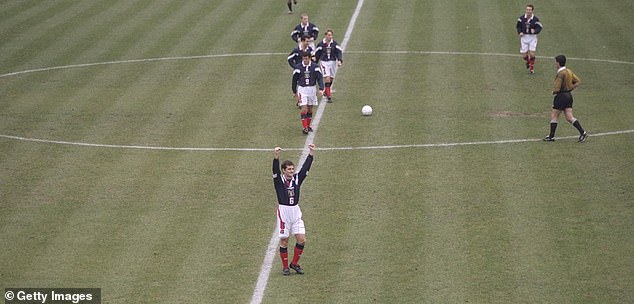
Whilst many mistook their intransigence for a bluff, the hosts were nowhere to be seen as kick-off approached, leading to the bizarre sight of Yugoslavian referee Miroslav Radoman leading the Scots alone onto the pitch shortly before 3pm.
As the hundreds-strong travelling Tartan Army resorted to time-honoured gallows humour, belting out ‘One Team in Tallinn’, Billy Dodds – making his first start for his country – passed the ball to John Collins to get the game under way. The Monaco man, captain for the day in the absence of the suspended Gary McAllister, managed two touches in the empty opposition half before Radoman blew his whistle to abandon the game.
Collins punched the air in mock celebration as the rest of the team trudged back towards the dressing room. They showered, changed and were at the airport awaiting their return flight home by the time the Estonians, led by Icelandic coach Teitur Thordarson, arrived in time for the originally scheduled kick-off.
It was, as Burley admits, a surreal sequence of events. ‘I’ve never experienced anything like it before or since,’ the ex-Celtic man tells Daily Mail Sport. ‘I’ve got to be honest, I hated the whole thing.
‘It was a shambles. When we got to the ground, I’d already made up my mind that I didn’t want to play. I clearly remember being on the pitch warming up and looking over towards where their bus would have arrived, thinking, “Please don’t show up”. I was embarrassed by it all.’
Burley recalls his exasperation at the unfolding farce being in stark contrast to the mood of Scotland coach Brown. ‘Craig had a tendency to get paranoid and he was absolutely adamant they were going to show up five minutes before kick-off, step off the bus in their full kit, and basically ambush us.
John Collins receives the ball from debutant Billy Dodds and sets off into the opposition half
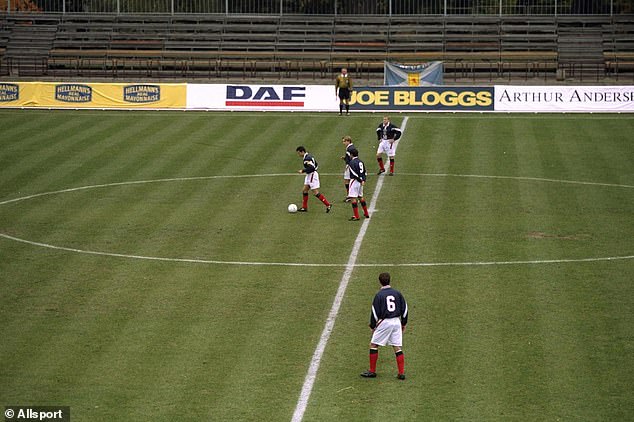
‘He was genuinely in a bit of a panic about it, and I remember him being annoyed at some of the guys for not taking things seriously. I mean, looking back, we were definitely taking the p*** a little bit and joking around.
‘It was as though we were preparing for a game against the Under-19s, not a World Cup qualifier. That really riled Craig. He was always worried about other people’s perceptions of him and his team. Even as we were about to walk out for kick-off, he was saying: “No larking around, lads. This still might happen”.
‘At the time, I remember wondering why he was getting himself so worked up. It seemed pretty obvious to me that they weren’t going to show. But, looking back now, he must have felt enormous pressure. We had drawn with Austria in our opening game of the group and had beaten Latvia a few days earlier in the second. If Estonia had shown up, sniffed blood because we weren’t treating it seriously and then beaten us, that would have put us in a really difficult position to qualify for France ’98.
‘There’s a good chance that World Cup might not have happened for us and Craig might have got the sack. I couldn’t understand his mindset back then but, looking back now, I completely get it. It had the potential to be the mother of all upsets.’
As the players retreated back inside the stadium, some Scottish supporters spilled onto the pitch where the match ball had been left behind. Iain Hadden was amongst them. The 60-year-old Aberdonian has followed Scotland home and away since the early nineties but insists he has never experienced anything like the trip to Tallinn.
‘It was a bit of a mission getting there in the first place,’ he recalls. ‘We had travelled on a bus from Latvia after the first game in that double-header and I remember our passports being taken from us at gunpoint in a forest somewhere around the border. That was a hairy couple of hours. To go from thinking we weren’t going to get out of there to then seeing a game that didn’t happen, aye, it was quite something.
Collins shares a laugh with the officials at the Kadrioru Stadium after Estonia's no-show
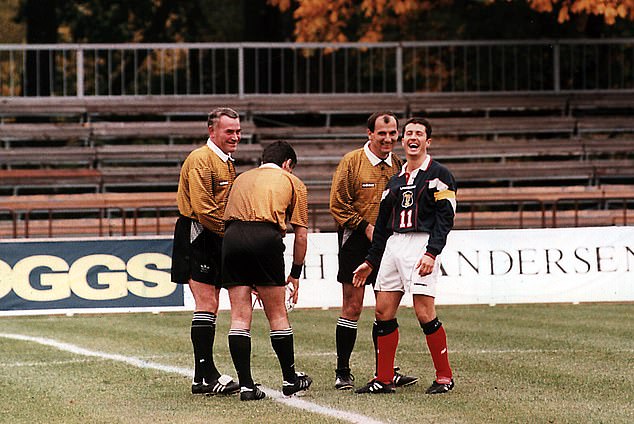
‘After the ref blew to abandon the match, a good few of us jumped the fence, got onto the pitch and went away with the match ball. There must have been about 20 Scots, all drunk. We actually played with two of the Estonian players who had turned up. If I’m remembering correctly, it was their substitute goalkeeper and a defender. They had the full kit on and we had a good kick-about with them.
‘We’d been at it for about half an hour when some folk from the SFA came on and said, “Right, you’ve had your fun but you’ll need to stop now because the police are threatening to take the muzzles off the dogs”. Sure enough, there were local officers standing at the sidelines with these great big Rottweilers. So that was that. It certainly wasn’t the game we expected.’
Back in Scotland, Dougie Donnelly had started his day preparing to anchor live coverage of the original evening match alongside studio analyst Gordon Smith when news broke of the rescheduled kick-off time.
‘We were expecting to do an evening match like everybody else when, suddenly, we got word that it was shifting to the afternoon,’ recalls the veteran broadcaster. ‘That changed our plans completely.
‘The BBC was already planning to broadcast the memorial service for the Dunblane tragedy that afternoon, and there was no way we were going to show a football match at the same time as something that important.
‘So, the plan became that I would go on-air to do a ten-minute update at half-past four. That was all fine until we got wind from one of our outside broadcast team out in Tallinn that Estonia hadn’t shown up. We were all just left scratching our heads and looking at each other. It was utterly bizarre.’
The collective incredulity was compounded when the expected 3-0 default victory for the Scots was later overturned by FIFA, the sport’s top brass ordering the match to be replayed at a neutral venue in a move that incensed Brown and his SFA cohorts.
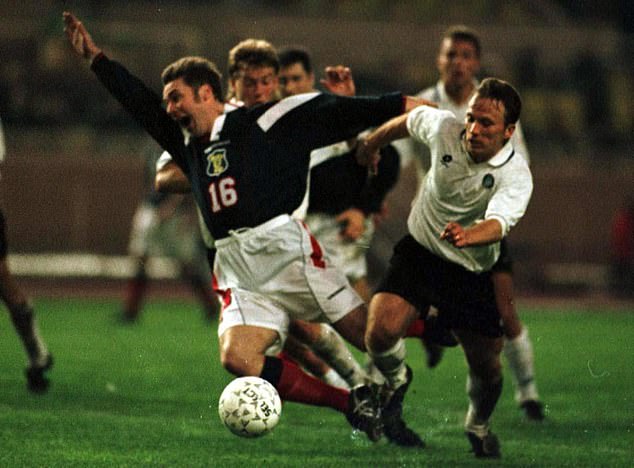
The Estonians had the last laugh by frustrating Scotland in a goalless rematch in Monaco
‘Craig was convinced that Scotland were being stitched up by Lennart Johansson,’ adds Donnelly. ‘He was the president of UEFA and a vice-president of FIFA at the time. He was also Swedish, and we had the Swedes in our qualifying group.
‘There was established precedent for awarding a victory by default under these kinds of circumstances, but we were made to play the game again, this time in Monaco. Craig was convinced this was all at the insistence of Johansson in the hope that we’d slip up — which would, of course, have benefited Sweden.’
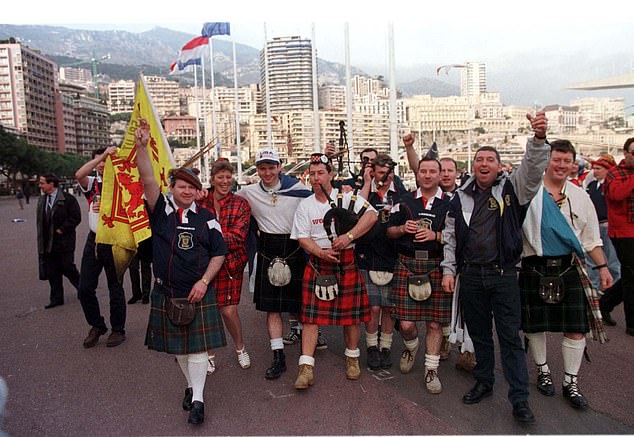
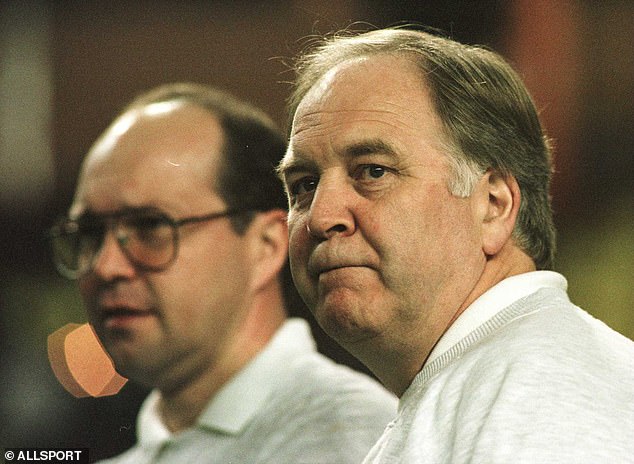
The rearranged match, played in February 1997, ended in a goalless draw to further antagonise Brown. And whilst not as chaotic as the initial clash, the game in Monte Carlo was memorable for many reasons of its own.
For one thing, it proved to be the final Scotland appearance for both Ian Ferguson and his namesake Duncan. The former was caught appearing to swear at Scotland supporters as the players left the pitch at full-time. Although he subsequently apologised, the Rangers man never again represented his country.
By contrast, the game proved to be the making of Estonian goalkeeper Mart Poom. A succession of fine saves to keep the Scots at bay earned the then 25-year-old a dream move to the English Premier League with Derby County where, as fate would have it, he later became a teammate of Burley.
The Tartan Army make the most of their unexpected visit to Monaco to take on Estonia
‘We played alongside one another for around four years but not once did we ever discuss those matches,’ laughs the Scot. ‘I genuinely don’t know why it never came up. You’d think it would have.
‘But what a top man he was. And a top professional, too. He was probably the fittest player I ever played with. We used to call him Dolph, after Dolph Lundgren. I remember he could beat all of the outfield players in the bleep test. We’d all be lying on our backs completely spent and he’d still be cruising along, back and forth.
‘He was a machine and, as much as the rearranged match was a huge pain for us, I’m really pleased that it worked out so well for him. He deserved it.’
For Hadden, the trip to Estonia left a bitter taste, despite all of the on-field fun that followed. ‘When they decided to replay the game in Monaco, I wrote to the SFA,’ he says. ‘I told them I wanted to be reimbursed the £1,100 that I’d spent going to the games in Latvia and Estonia.
'They replied to say I should take it up with UEFA. So, me and many of the other supporters who made that trip wrote to them, threatening to sue, but we got the cold shoulder.’
Despite all the angst and inconvenience, Scotland ultimately had the last laugh. They finished second in Group 4 behind Austria, two points ahead of Johansson’s Sweden, to qualify for France ’98.
Scotland manager Craig Brown was left to rue what might have been after stalemate in Monaco
There were wins home and away against Latvia and Belarus, a crucial 1-0 victory at home to the Swedes, and a pivotal 2-0 win against the Austrians at Celtic Park. And yet none of those are remembered as readily as the game that never was – all three seconds of it – in Tallinn.
‘It’s one of those things that just resonates with a lot of people,’ shrugs Burley.
‘It’s funny, I saw a picture on social media the other day. It’s of [Ally] McCoist running away to celebrate after scoring against Greece in a qualifier for Euro ’96. I’m running behind him with Robbo [John Robertson] chasing after us. That was a huge moment and a massive game.
‘I’m willing to bet most people can’t remember it. But if you say the word Tallinn to them, they’ll go, “Oh aye, that time the other team didn’t show up”. It’s crazy to think it’s 30 years ago and even more surreal that it happened in the first place.’