
'/%3e%3cdefs%3e%3clinearGradient%20id='prefix__paint0_linear_4737_37157'%20x1='3.018'%20y1='23.6'%20x2='44.925'%20y2='24.977'%20gradientUnits='userSpaceOnUse'%3e%3cstop%20stop-color='%231CB7FF'/%3e%3cstop%20offset='.502'%20stop-color='%232FF58B'/%3e%3c/linearGradient%3e%3c/defs%3e%3c/svg%3e)


The evolution of Premier League pitch management – with Arsenal at the forefront
Oct 04 2026 20:48 · By onefootball.com · 6 Reads


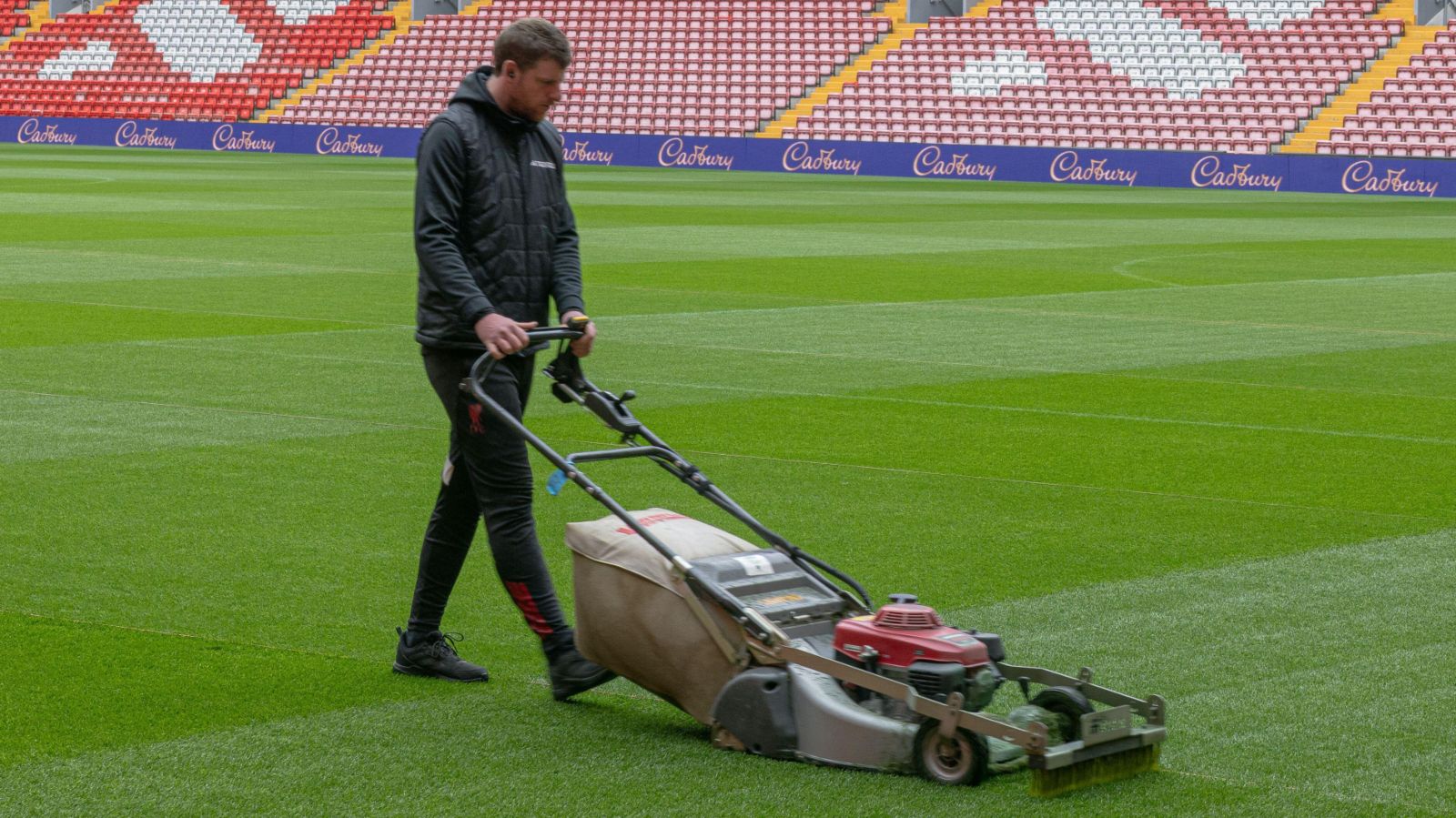
Premier League pitches have never looked better. Even in the depths of winter, when English football once resembled a particularly muddy agricultural pursuit, the playing surfaces at the country’s biggest clubs remain almost impossibly pristine.
Maintaining those standards is becoming an increasingly complicated business, however. Longer dry spells, intense rainfall and rising temperatures are creating new challenges for grounds teams, while the pressure to reduce football’s environmental impact is forcing clubs to rethink how they maintain their pitches.
According to Neil Rodger, a project director at sports-surface specialists STRI, who’ve worked closely with the Premier League and its clubs, the scale of the work involved is already considerably greater than most supporters appreciate.
“We used to think of it as just a groundsman, a one-man job, but that’s very much not the case,” Rodger tells Football365. “A lot of grounds teams these days will have at least three or four full-time staff looking after the stadium pitch, with a lot of extra help on matchdays.”
Water is among their most important resources. Elite pitches are predominantly constructed using sand-based rootzones, requiring careful irrigation to maintain stability, protect the grass and produce the slick surfaces players prefer.
Rodger estimates that, in extreme heat, irrigation could reach around 120,000 litres across an approximately 8,000-square-metre playing area in a day. That is an illustrative peak rather than a typical daily requirement, but it demonstrates the quantities involved.
“On a hot day, you’ll be watering before the players warm up, after the warm-up before kick-off and then again at half-time,” he explains.
The problem is that water is becoming less predictable. England experienced widespread drought conditions during the summer of 2026, with sports facilities increasingly having to consider how they will maintain playing surfaces through extended dry periods. STRI has warned that the challenge is not simply water scarcity, but the difficulty of capturing and storing rainfall when it is available.
Some Premier League clubs are already responding. Manchester City say their 16 training pitches are now irrigated exclusively using harvested rainwater, with the club reporting – for all that’s currently worth – savings of 80 million litres of clean water since July 2023. Arsenal, meanwhile, have operated a recycling system at London Colney since 2011, collecting between 15 million and 20 million litres annually.
Rodger believes similar systems could become increasingly common.
“The infrastructure isn’t some science-fiction, futuristic thing. It’s existing, proven technology,” he says. “It’s mainly a question of cost and the investment required to upgrade a pitch to include those systems.”
But drought is only half the problem. Heavy downpours can overwhelm playing surfaces, making efficient drainage just as important as retaining water.
Traditionally, pitch designers have concentrated on removing excess rainfall as quickly as possible. Now the emphasis is shifting towards capturing that water rather than allowing it to disappear into drainage networks.
One emerging approach is subsurface irrigation, which stores water beneath the pitch and allows grass roots to absorb it from below.
“It’s a more efficient way of irrigating because you’re not losing as much water through evapotranspiration,” Rodger explains.
Conventional sprinklers remain necessary for preparing the playing surface, but increasingly sophisticated systems are changing how grounds teams manage irrigation. Moisture sensors can provide live readings from different areas of a pitch, allowing individual sprinklers to be controlled according to the conditions.
“At the top level, the days of a groundsman simply thinking the pitch looks dry and turning the sprinklers on are gone,” Rodger says. “It’s very calculated, controlled and precise now.”
Technology cannot eliminate every problem, though. Rodger says warmer conditions are bringing turf diseases into southern England that were previously more commonly associated with continental Europe.
At the same time, restrictions on certain chemicals are changing the methods available to grounds teams.
“You’ve got more challenging climatic conditions and more challenging legislation. It’s a double whammy.”
There are also established maintenance practices that Rodger believes football will eventually regard as unnecessarily wasteful.
Fertiliser is one example. Maintaining immaculate grass requires careful feeding, but excessive applications can lead to nutrients being washed through the soil and into the wider environment.
“I think in 10 years we’ll probably look back and think we were putting way too much fertiliser on,” he says.
Artificial lighting is another. Stadiums frequently use large lighting rigs to compensate for areas of grass deprived of natural sunlight. Modern LED systems are considerably more efficient than older lighting technology, although Rodger believes clubs should also examine whether they are using more artificial light than necessary.
His advice to Premier League clubs is straightforward: assess lighting requirements properly, invest in rainwater harvesting and adopt Integrated Turf Management principles to reduce unnecessary chemical inputs.
None of this means accepting poorer playing surfaces. The ambition is to maintain the quality modern football demands while reducing the resources needed to achieve it.
“I think it’s definitely doable, and technology is helping,” Rodger says. “But it is a challenge.”
For supporters, the difference may be almost invisible. The grass will still be immaculate, the ball will still zip across the turf and the sprinklers will still emerge before kick-off. The biggest changes to football’s pitches could be happening underneath them.