
'/%3e%3cdefs%3e%3clinearGradient%20id='prefix__paint0_linear_4737_37157'%20x1='3.018'%20y1='23.6'%20x2='44.925'%20y2='24.977'%20gradientUnits='userSpaceOnUse'%3e%3cstop%20stop-color='%231CB7FF'/%3e%3cstop%20offset='.502'%20stop-color='%232FF58B'/%3e%3c/linearGradient%3e%3c/defs%3e%3c/svg%3e)


The map showing world's division over Infantino
Aug 11 2026 12:50 · By www.bbc.com · 5 Reads


Gianni Infantino's previously untouchable status at the top of world football is now under significant pressure
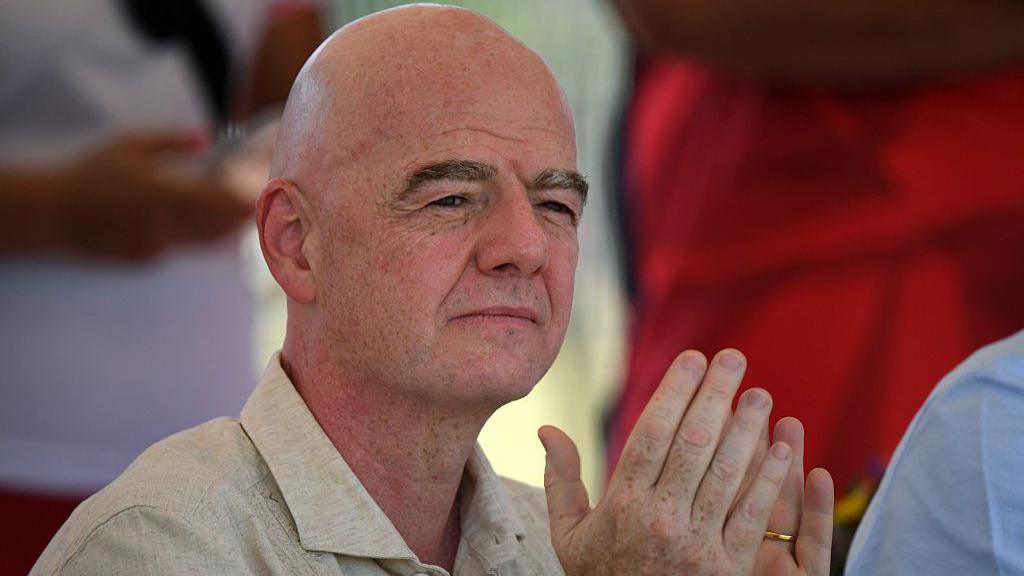
As recently as mid-July, Gianni Infantino was considered a shoo-in to be re-elected as Fifa president next March.
All but a handful of Fifa's 210 members had endorsed his bid for a fourth term in charge of world football, and he faced no meaningful challenge from any quarter.
But that picture looks very different now, after two weeks of relentless fallout to his now-abandoned plan to sell off stakes in the World Cup and other competitions to private investors.
The world is far from united over whether Infantino should stay or go.
In some cases, countries have publicly stated their overt support or opposition regarding Infantino.
Whereas once Infantino looked set to saunter to a fourth term unopposed, he now might need to have enough numbers on his side to stay in post.
If a unity candidate is found to oppose him, then the election would become a direct battle.
Fifa election votes between two candidates require a simple majority - each candidate would require a total of 106 votes to win.
If there are three or more candidates, a first-round win requires two thirds of the vote. If there is no winner, there is a second round where a simple majority is needed.
Europe has 55 votes, Africa 54, Asia 46, North America 35, Oceania 11 and South America 10.
But while the current tally looks like 73 in support of Infantino, 124 in opposition to him and 13 undecided, that picture is fluid and is likely to change in the months ahead.
Several European countries, including England and Wales, have formally withdrawn letters of support for Infantino that they had sent for next year's election.
On Monday, the backlash against Infantino intensified when European governing body Uefa, North America's Concacaf and the Asian Football Confederation (AFC)
signed a joint letter
accusing him and Fifa of breaking their trust "through deception".
It is a significant coalition, and those regional governing bodies represent 136 associations between them.
But there are already dissenting members within the confederations, like Bhutan, the Philippines, and the UAE within Asia, who have all backed Infantino.
Indeed, Asia is considered a potential swing region for Infantino's future, with many associations not yet making their position known.
Mexico has broken ranks within Concacaf by coming out in support of Infantino, too. The USA and Canada have stated support for Concacaf's latest statement, but have not outright declared their opposition to Infantino's rule.
Infantino still has staunch allies too, particularly within Africa (Caf) and South America (Conmebol), who have benefited from unprecedented investment since he took over a decade ago.
That investment could help him gain critical votes from nations within AFC, Concacaf and OFC - who are lower down the football food chain and have benefited significantly from the Fifa Forward programme, which has made billions of dollars available for investment.
And Saudi Arabia - which has yet to take a public position but was awarded hosting rights for the 2034 World Cup on Infantino's watch - will have its own football leadership elections in August. The results could dictate the kingdom's position, and influence the view of others in the region.
It cannot be guaranteed that every nation will toe the line of their confederation.
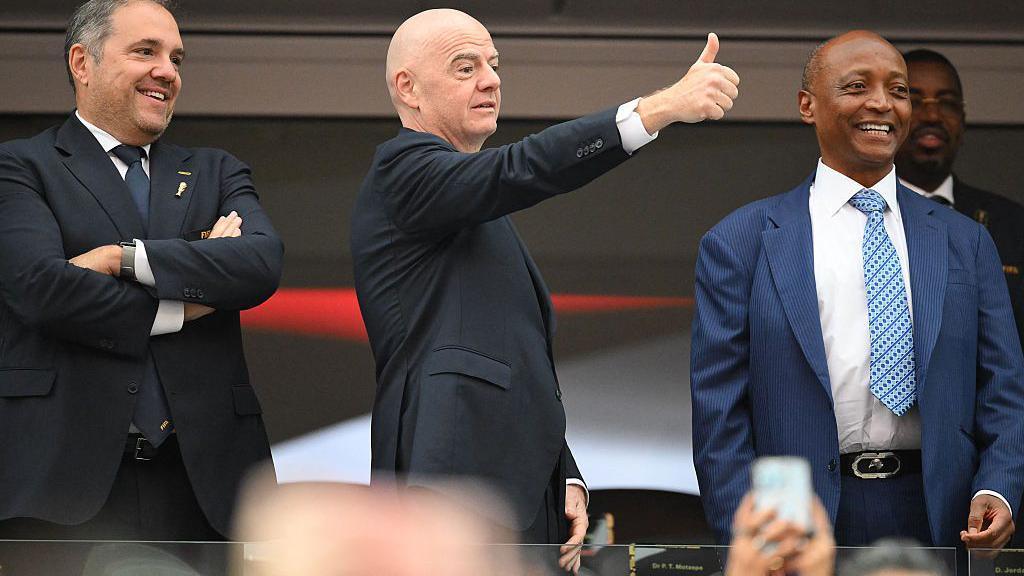
While Caf president Patrice Motsepe (right) remains a key ally of Infantino, Concacaf leader Victor Montagliani (left) could emerge as his most serious challenger
Infantino has shown no desire to step down, but there is a chance that his time in charge could be over by the autumn.
That could come to pass if Fifa Council members try to force his resignation at an emergency meeting.
Such a meeting can be called, and must take place within a fortnight, if 19 of the 37 members call for it.
The council is made up of nine members from Uefa, seven from AFC, six from Caf, five from Concacaf, five from Conmebol, and three from Oceania. Also on the panel are Infantino himself and Fifa secretary general Mattias Grafstrom.
Given its makeup, then, this approach is probably unlikely.
Which leaves the possibility of a candidate standing against Infantino next March. Nobody has put their name forward yet, but if the leaders of Uefa, Concacaf, and AFC are serious about toppling Infantino, uniting behind a single candidate is likely their best option.
The deadline for a candidate to announce their intention to stand is November.
Historically, other confederations have been angered by European dominance of football, its competitions and its wealth.
That is perhaps why Concacaf president Victor Montagliani has been consistently mooted as the most likely challenger to Infantino in recent weeks.
The map of votes could change significantly based on who stands.
If AFC president Sheikh Salman were to step forward, for example, there is a chance that could sway some of the associations in Asia that are currently supportive of Infantino towards him.
For now, the global picture remains unclear because of emerging splits within confederations, the potential for key players to declare one way or another in the coming months and the hitherto lack of a clear candidate to challenge Infantino.
What is clear is that Infantino is no longer coasting towards a fourth term, if he clings on that long.