
'/%3e%3cdefs%3e%3clinearGradient%20id='prefix__paint0_linear_4737_37157'%20x1='3.018'%20y1='23.6'%20x2='44.925'%20y2='24.977'%20gradientUnits='userSpaceOnUse'%3e%3cstop%20stop-color='%231CB7FF'/%3e%3cstop%20offset='.502'%20stop-color='%232FF58B'/%3e%3c/linearGradient%3e%3c/defs%3e%3c/svg%3e)


The secret salary of Gianni Infantino that set off alarm bells before the historic slam of the door at FIFA
Aug 03 2026 12:49 · By IVÁN CAMILO CASTIBLANCO · 53 Reads


A report by the British press revealed the multimillion-dollar sum that the Swiss executive was set to receive if the commercial privatization of the World Cup went ahead
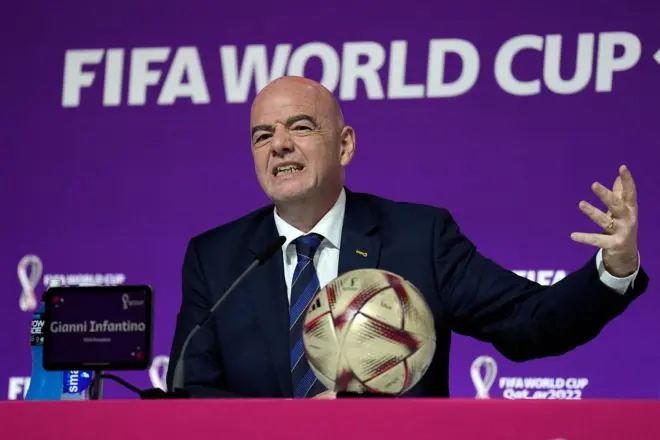

'A scandal of historic proportions is shaking the foundations of FIFAafter the true figures behind the failed privatization of the planet's most important tournament came to light. Just hours after world football's top governing body had to backtrack on its controversial project, an exclusive report revealed the enormous personal financial gains that were hidden behind the initiative.'
The plan, which promised to restructure the financial model of international competitions, ended up triggering an unprecedented rift among the highest ranks of global football. The institutional storm began to take shape amid accusations of a lack of transparency and maneuvers to concentrate commercial power in an extremely small group of trusted executives.
However, the trigger for the massive backlash was the discovery of the shocking compensation package prepared for the top leadership. The leak of the proposal’s internal documents not only brought the measure to a halt, but also put executive ethics under the microscope at the moment of greatest political tension in recent years.
A salary ten times higher
According to an investigation published by the prestigious British newspaper The Times and reported in the region by TN, Gianni Infantino had planned to become the managing director of the new subsidiary company. In this role, the Italian-Swiss executive would have gone on to receive a sum close to 30 million euros annually (34.3 million dollars), plus hefty bonuses for commercial performance.
The figure is truly chilling when compared with the usual income Infantino receives as FIFA president, currently standing at around 3 million euros a year. With the approval of the creation of this private entity, his personal earnings would have automatically increased tenfold exponentially.
The project in question, called FIFA Forward Enterprise (FFE), envisaged the creation of a commercial subsidiary responsible for exploiting television rights, sponsorships, ticketing, licensing, and the organization of the World Cup itself. The strategy sought to open up 20% of this multibillion-dollar business to private funds and external capital investors.
A multimillion-dollar business for a select few
Through the entry of this private capital, the top leadership aimed to raise an immediate financial injection estimated at around 3.65 billion euros. However, behind the official discourse focused on the "global development of football," the controversial proposal contained attractive salary incentives and key executive positions designed for only a select few.
Among the figures slated to join the subsidiary's management structure were leaders of enormous weight on the international stage. Names such as Qatari Nasser Al-Khelaïfi, president of Paris Saint-Germain; Bahraini Salman bin Ibrahim Al-Khalifa, head of the AFC; and Canadian Victor Montagliani, president of Concacaf, were part of the initial draft.
This distribution of power quotas caused immediate discontent among the excluded federations, which interpreted the move as an attempt at covert privatization of the assets of all the national teams. Alarm bells rang when it became clear that the strategic decisions of football would be subordinated to the economic benefit of the investors.
The UEFA's tough stance
The plan collapsed when it crashed head-on into a wall of resistance led by Aleksander Čeferin and UEFA. The governing body of European football reacted forcefully, accusing the initiative of a troubling lack of transparency, immediately withdrawing its confidence in Infantino’s management and threatening a total boycott of the parent body's competitions.
The institutional rebellion did not take long to spread to other continents. Hours after Europe’s firm stance, Concacaf and the Asian Football Confederation (AFC) issued their own official statements backing the blockade and demanding a thorough review of the governance and financing of world football’s reserves.
Faced with the imminent risk of a total rupture within world football, FIFA was forced to issue an official retraction statement to definitively cancel the FFE project. In its defense, the organization stated that "football is not for sale" and argued that the initiative only sought to find financial alternatives, although the damage to its institutional image was already irreversible.
An institutional earthquake that never ends
The revelations about the enormous salary Infantino intended to collect leave the leadership in a position of extreme political fragility. With influential voices within the confederations calling for external audits and greater transparency controls, the governance crisis at FIFA promises to add new chapters in the coming weeks.
Various analysts and international media agree that this setback marks a before and after in the administration of global football. The distrust sown among European and American leaders will make any future attempt at commercial reform that does not have the absolute consensus of all the parties involved more difficult.
For now, the continental bodies have warned that they will remain vigilant against any new attempt to market official competitions unilaterally. The battle for control of the football business remains open, while the credibility of the top authorities is going through its most critical moment.