
'/%3e%3cdefs%3e%3clinearGradient%20id='prefix__paint0_linear_4737_37157'%20x1='3.018'%20y1='23.6'%20x2='44.925'%20y2='24.977'%20gradientUnits='userSpaceOnUse'%3e%3cstop%20stop-color='%231CB7FF'/%3e%3cstop%20offset='.502'%20stop-color='%232FF58B'/%3e%3c/linearGradient%3e%3c/defs%3e%3c/svg%3e)


Why Gianni Infantino is 'untouchable', how the FIFA president can be stopped and who could replace him: All the big questions answered amid fury over plans to sell stakes in the World Cup
Jul 29 2026 20:48 · By Bobby Manzi · 27 Reads


FIFA have set the wheels in motion on a radical plan to sell stakes in the World Cup to private investors.
In proposals exposed on Tuesday, it emerged that FIFA want to set up a subsidiary to control the operational delivery of tournaments and their commercial interests – such as ticketing and TV rights.
FIFA hopes to raise over £3billion from investors for the project, with investment bank J.P. Morgan advising world football’s governing body.
American venture capitalist firm Thrive, of which Joshua Kushner – brother of Donald Trump’s son-in-law Jared – is CEO, are expected to lead the proposed investor group.
Despite FIFA maintaining that outside investors will not play any operational role, there are grave concerns that investor interest will increase the frequency of tournaments – such as the Club World Cup and World Cup – to help maximise the return on investment.
Football associations are being incentivised to support the proposition with the promise of £15million in additional revenue.
Daily Mail Sport digests the biggest danger to football since the European Super League.
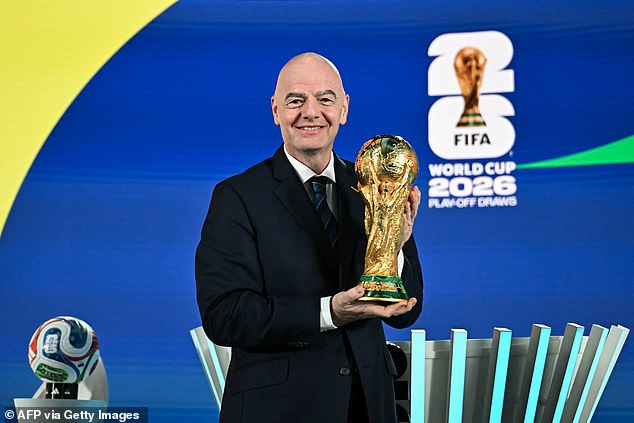
FIFA president Gianni Infantino has set the wheels in motion over a racial plan to sell stakes in the World Cup to private investors in a highly controversial move
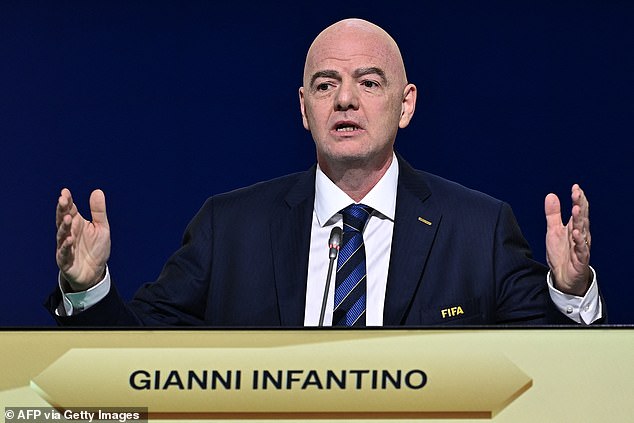
It’s simple: he’s the money man. FIFA’s voting system of one association, one vote means that each national association – regardless of size or standing in the game – gets one vote on FIFA policy and presidency.
Therefore, the English FA has the same influence as Botswana's FA, despite the African nation having never qualified for a World Cup.
It allows Infantino to lobby and curry favour with smaller nations by promising increased funding and expanded tournaments. His masterplan is to increase the 2030 World Cup to 64 teams, meaning 30 per cent of FIFA nations would be present at the tournament.
More teams, more matches, more revenue. That promise is too transformational for smaller nations to turn down. The FA, whose turnover is over half a billion per year, can perhaps afford to take the moral high ground.
Infantino has tactically created a block vote of those who need the money – particularly nations from the African federation – to support and protect his presidency, giving him a free pass.
Then there are the likes of San Marino and Curacao, where an extra £15m in revenue – generated by these new plans – offers unprecedented funding for football projects.
At this summer’s expanded World Cup, Curacao earned £7.5m while Cape Verde banked £9m – it's plain to see the appeal of a lucrative 64-team tournament to minor nations.
Earlier this year, the South American, African and Asian confederations said they would back Infantino for another four years as FIFA president. Those three associations represent 111 countries, with Infantino needing the support of 106 to win another term. Unless they withdraw their support, he has already won.
UEFA, the Asian Football Confederation (AFC) and Conmebol have all voiced organisational concerns about the project and the lack of consultation. But it is down to each nation to set their respective stance.
Infantino is backed by a large number of smaller nations who benefit from FIFA's funding
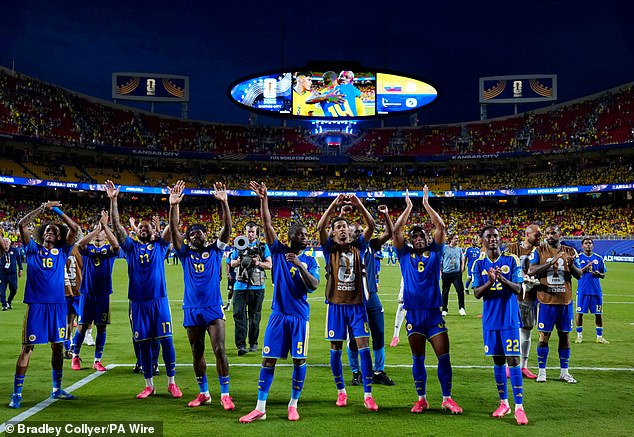
Curacao were among those to benefit from Infantino's expansion of the World Cup to 48 teams
UEFA are set for crisis talks on Thursday as they attempt to get all 55 UEFA nations pulling in the same direction. However, that effort has already hit a roadblock, with the president of the Czech FA, David Trunda, backing Infantino’s plans.
Even if the talks build consensus, UEFA would still be 51 associations short of blocking Infantino’s plan – and that is assuming all UEFA nations agree to vote it down, which already looks unlikely.
Concacaf and the AFC have already voiced their concerns, but their member nations are much more susceptible to accepting FIFA’s cash incentives.
There is another way, though. UEFA could pressure FIFA by threatening to withdraw from the next World Cup, but that would require unprecedented collaboration. Even then, it could be seen as an empty threat with the next tournament four years away – although it could still scupper the upcoming broadcast tender process.
However, the Women’s World Cup is just around the corner, and any threat to derail it would have to be taken more seriously. That will surely be on Thursday's agenda.
But those decisions are down to each nation – UEFA can only act as a broker, facilitating talks in the hope of mobilising associations behind the same course of action.
Take Spain, for example. They will be determined to defend their crown as women’s world champions, so it will be difficult for UEFA to persuade them to pressure FIFA by threatening to withdraw.
The dissent is encouraging, but stopping Infantino presents an almighty challenge.
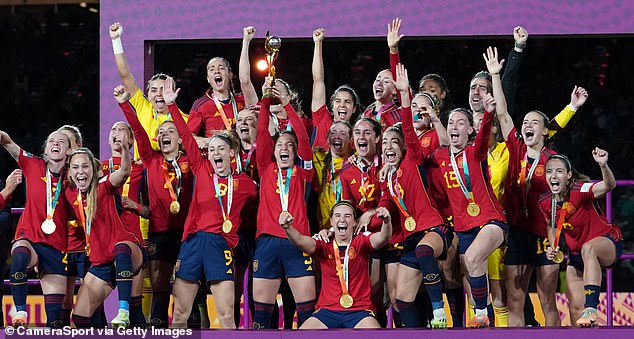
Next year's Women's World Cup would be the next realistic event if nations were to threaten a boycott
UEFA's two damning statements aimed at Infantino are the latest flashpoint in an increasingly turbulent relationship between European football's governing body and FIFA. Reflecting on the plans, UEFA said FIFA have ‘crossed a line’ – it is the second time they have aimed that phrase at FIFA this summer.
Tensions between UEFA president Aleksander Ceferin and Infantino have been public since FIFA unveiled plans to expand the Club World Cup, stretching an already congested calendar and threatening the commercial dominance of the Champions League.
FIFA's biggest revenue driver is the men's World Cup, held every four years, with the latest edition generating £11.2bn, while UEFA benefits from both the European Championship and the Champions League.
Over a four-year cycle, the Champions League generates more revenue than the World Cup – bringing in around £3.7bn annually.
That disparity has long frustrated Infantino, and the launch of the 32-team Club World Cup represented FIFA's attempt to establish a lucrative club competition under their own control.
FIFA is now considering a further expansion to 48 teams from 2029, heightening UEFA’s concerns that an enlarged Club World Cup could dilute the value of European club football.
Relations deteriorated further at FIFA's annual Congress in May 2025 when Infantino arrived more than two hours late after accompanying US President Donald Trump on a diplomatic tour of the Middle East. During a break, Ceferin led a walkout before UEFA accused the FIFA president of putting "private political interests" ahead of football's governance. He boycotted the following year.
Tensions between UEFA president Aleksander Ceferin and Infantino have been played out in public, with Europe's governing body this week claiming the plans have 'crossed the line'
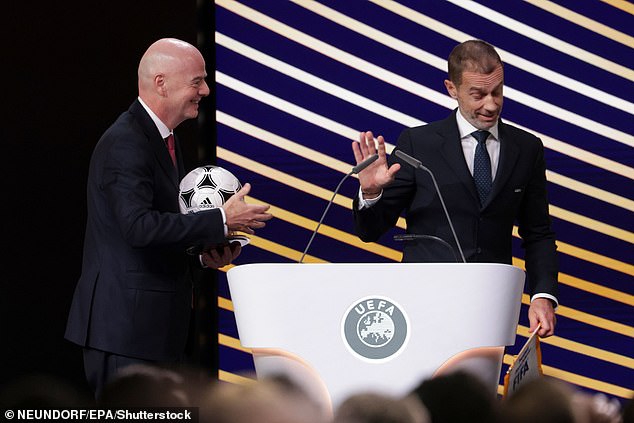
Infantino's close relationship with US president Donald Trump has also let to friction with UEFA
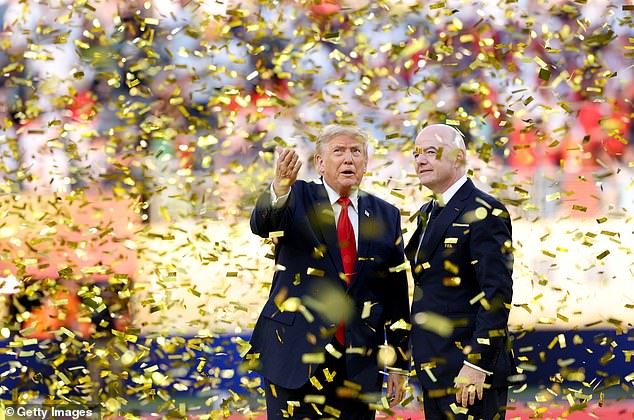
That was not his last no-show either. Ceferin failed to show up for Spain’s World Cup final win over Argentina earlier this month – disillusioned with the FIFA president and his antics during the tournament.
Infantino took a call from President Trump, where he pleaded with him to investigate Folarin Balogun’s red card and subsequent one-game ban. FIFA’s one-man disciplinary council then suspended the ban for a year as a workaround for the absence of a mechanism to overturn a red card at the World Cup, an unprecedented step.
They have also indirectly criticised FIFA by awarding the Super Cup final to the Somalian referee who was due to officiate at the World Cup before his visa was revoked and announcing low ticket prices for Euro 2028 while FIFA were facing criticism for extortionate ticket prices.
Despite Infantino’s position as FIFA president seeming entrenched right now, there remain eight months until the next elections – so there is still time for a challenge to be mounted.
However, the deadline for candidates to formally present their nominations with the support of at least five national federations is November 18.
In the previous election in 2023, Infantino ran unchallenged. That is unlikely to be the case in 2027 with the growing opposition – but candidates may be fighting a losing battle with 111 nations already backing Infantino.
PSG president Nasser Al-Khelaifi – who is the chairman of Bein Media and Qatari Sports Investments – is the most logical option to stand in opposition. He has backing from several European nations and is respected across the game.
PSG president Nasser Al-Khelaifi – who is the chairman of Bein Media and Qatari Sports Investments – is the most logical option to stand in opposition to Infantino as FIFA president
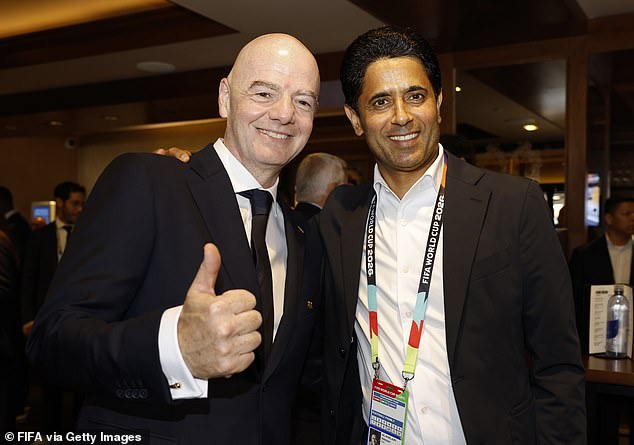
Al-Khelaifi is admired for his communication and his deep understanding of football governance. He is currently chair of the European Football Clubs group – the body which represents over 800 European clubs – which criticised FIFA’s investment plans.
The Qatari is a member of UEFA’s executive committee, making him the first Asian to hold a UEFA position, which could help him to win support from two continents.
It has also been reported that Dariusz Mioduski, the Polish owner and president of Legia Warsaw, may be a potential rival to Infantino. Victor Montagliani, the president of Concacaf and vice-president of FIFA, has not ruled out a future run for the presidency – although he is expected to seek re-election with Concacaf next year.
Meanwhile, president of the German Football Association Bernd Neuendorf declined to endorse Infantino’s re-nomination, while La Liga chair Javier Tebas has called for Infantino to step down.