
'/%3e%3cdefs%3e%3clinearGradient%20id='prefix__paint0_linear_4737_37157'%20x1='3.018'%20y1='23.6'%20x2='44.925'%20y2='24.977'%20gradientUnits='userSpaceOnUse'%3e%3cstop%20stop-color='%231CB7FF'/%3e%3cstop%20offset='.502'%20stop-color='%232FF58B'/%3e%3c/linearGradient%3e%3c/defs%3e%3c/svg%3e)


World Cup heatwave sparks safety fears ahead of France v Paraguay clash in Philadelphia
Jul 08 2026 17:03 · By onefootball.com · 36 Reads


Open menu
OneFootball's home page
Search
Settings
Sign In
The Independent
·
3 July 2026
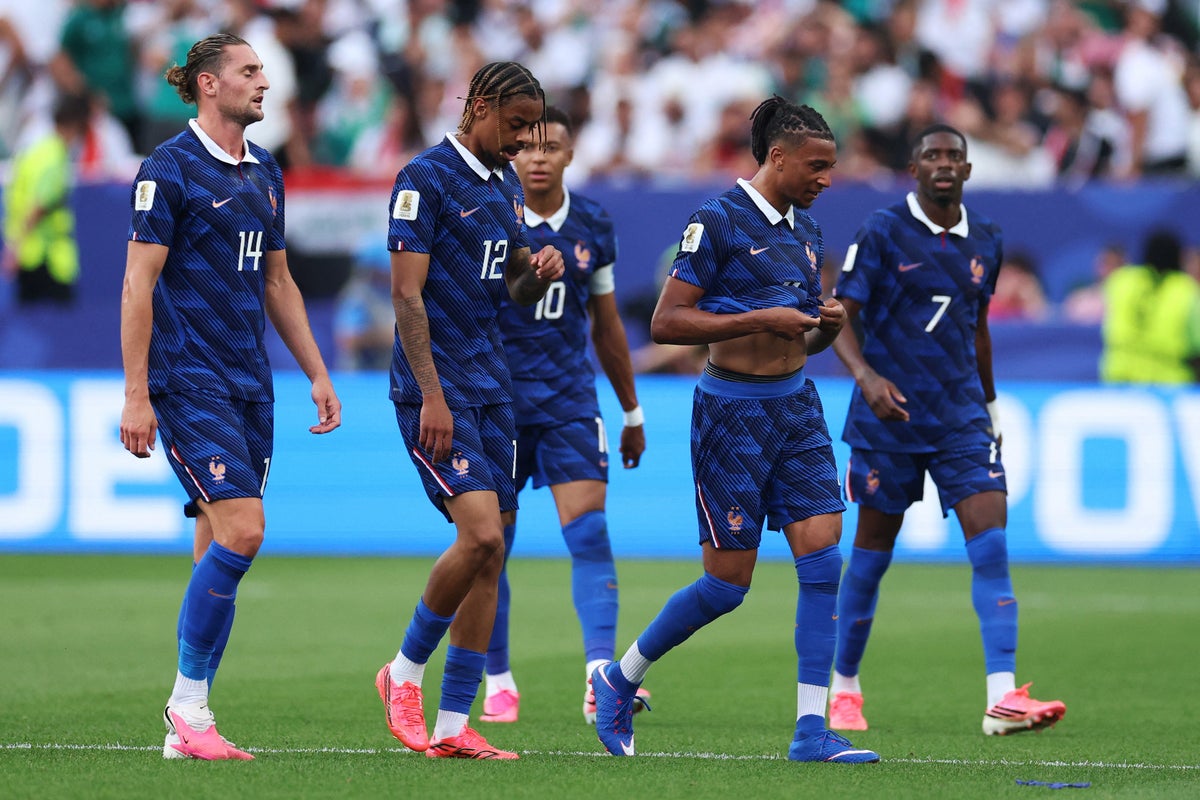
A crucial
World Cup
knockout match between
France
and
Paraguay
in
Philadelphia
this Saturday is set to become one of the tournament's hottest, raising serious health concerns for players, tens of thousands of fans, and the wider region.
The fixture coincides with a severe
heatwave
gripping the eastern and central United States, where peak
heat
indexes are forecast to reach a dangerous 100 F to 115 F (37.78 C to 46.11 C), according to the
National Weather Service
. High overnight temperatures are expected to offer little respite, with records potentially being broken.
Concerns over extreme heat have intensified throughout the tournament, particularly after French players resorted to field sprinklers to cool down during their earlier match against Sweden in New Jersey, where temperatures hit 90 F (32.22 C).
Scientists have increasingly labelled Fifa's heat safety guidelines as "inadequate" and "impossible to justify”, even for heat-acclimatised athletes, warning that spectators could face slower, less intense games.
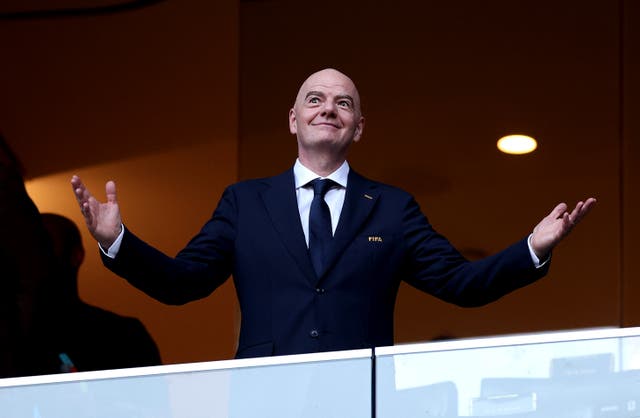
open image in gallery
Fifa has been criticised for having 'inadequate' heat safety guidelines (Getty)
The escalating heat crisis is inextricably linked to climate change. The world has warmed by approximately 1.26 F (0.7 C) in the three decades since the US last hosted the
, according to climate monitoring group Berkeley Earth.
This global temperature increase intensifies and makes heatwaves and other severe weather events more frequent. Scientists from the World Weather Attribution group stated on Friday that the humid heat currently engulfing parts of the US and Canada would have been "virtually impossible" without climate change.
This is not the first time extreme temperatures have plagued football's premier tournament. The 2022
in Qatar was controversially moved from summer to winter due to the severe heat threat, and last year's Club
also saw soaring temperatures.
The global union for professional footballers has repeatedly warned that extreme heat will likely pose an even greater problem at this and future World Cups, recalling the 1994
game in Orlando, Florida, which saw temperatures reach 110 F (43.33 C).
Heat presents a profound danger to athletes, impacting them both from their environment and from their bodies' internal warming during exercise.
This dual assault makes it significantly harder to cool down in hot and humid conditions, explains Bharat Venkat, director of the Heat Lab at the University of California, Los Angeles.
"So when you’re exerting yourself on a particularly hot day, the likelihood of experiencing heat related illness or even death is much higher," he cautioned. Intense physical exertion in scorching conditions can lead to extreme fatigue, impaired performance, headaches, irritability, nausea, dizziness, cramping, and dehydration – all symptoms of exertional heat illness.
Exertional heat stroke, which demands immediate medical attention, stands as the third leading cause of death amongst athletes.
Ryan Calsbeek, a professor of biological sciences at Dartmouth College, highlights that when the wet bulb globe temperature (WBGT) – a measure incorporating temperature, humidity, cloud cover, and wind – surpasses approximately 95 F (35 C), individuals lose their ability to cool rapidly, and "the physiological mechanisms just break down." He added that heat-induced confusion could also compromise a player's decision-making, potentially influencing a match's outcome.
Fifa's current heat safety protocols, including mandatory three-minute hydration breaks midway through each half, have drawn criticism. While intended to protect players and referees from extreme heat illness, some argue they disrupt the game's flow and offer coaches tactical advantages.
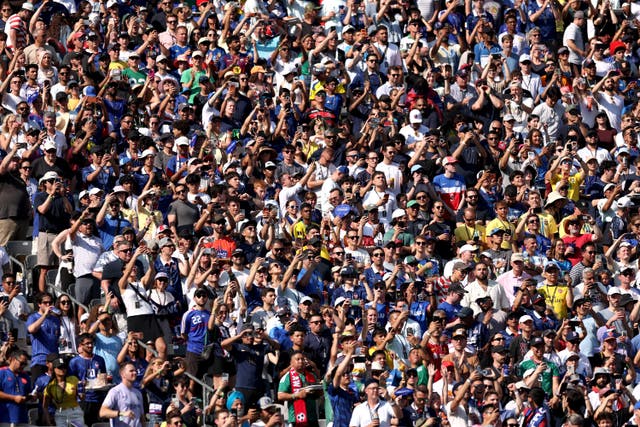
There are also concerns for fans attending the match (Getty)
Conversely, some scientists contend these breaks are too short to allow players to meaningfully cool and rehydrate in extreme conditions.
Furthermore, whilst matches outdoors during peak heat hours have been limited and those in warmer windows prioritised for covered stadiums, Fifa's guideline for postponing a match – only if the WBGT reaches 89.60 F (32 C) – has been widely challenged.
Douglas Casa, CEO of the University of Connecticut’s Korey Stringer Institute, noted that this temperature is "so extreme that in the military, at our basic training facilities in America, if it reaches 32, it’s black flag and all training has to be canceled and stopped."
With temperatures forecast to exceed 100 F (37.78 C) for Saturday's game, the players’ union
Fifpro
and the American College of Sports Medicine have advocated for matches to be delayed at a lower, safer threshold of 82.40 F (28 C).
Despite these challenges, teams are employing strategies to mitigate heat stress. Guilherme Passos, a sport scientist with the Brazilian Football Federation, monitors and prepares Brazil’s national team for extreme heat.
He has helped the team acclimatise to the US heat, advising against exposing them "straight to the hottest time of the day" to maintain training quality, and utilising saunas or hot baths for heat training during competition.
Passos observed that during the 2014
in Brazil, players covered less distance and reduced high-speed running, instead focusing on technical and tactical precision. Calsbeek emphasised that football players' unique blend of endurance, explosive speed, and critical decision-making are all severely impacted by temperature.
However, the risks extend beyond the pitch. Many football fans, often consuming alcohol, will be watching the
in these dangerous conditions.
Cities and stadiums have responded by increasing access to shade, cooling areas, water, and deploying medical personnel at Fifa Fan Festivals and around venues. Yet, Calsbeek warns, "People are going to be dehydrated, super excited, and not wanting to leave the match. We’re likely to see, in those extreme temperatures, spectators pay the price as well."
PREVIEW | Paraguay vs France: team news, lineups, predictions (World Cup 04/07)
Playmakerstats
France make it four wins from four, mirroring 1998
OffsAIde
Paraguay vs. France: How to watch, stream World Cup Round of 16
Major League Soccer
😳 What now, Paraguay? France racks up ABSURD records
OneFootball
France to potentially play Paraguay as Germany stunned in World Cup round of 32
Get French Football News

Predicting which clubs the summer's biggest free agents will sign for
There are still some massive names who are set to become free agents in the summer, with some high-profile deals due to expire at the end of next month.As speculation...
Tottenham: Why James Maddison was not awarded a penalty against Leeds as Premier League issue statement
Spurs midfielder denied a big moment on his return from injuryThe Premier League has explained why Tottenham were not awarded a penalty in their draw against Leeds.As the clock ticked...
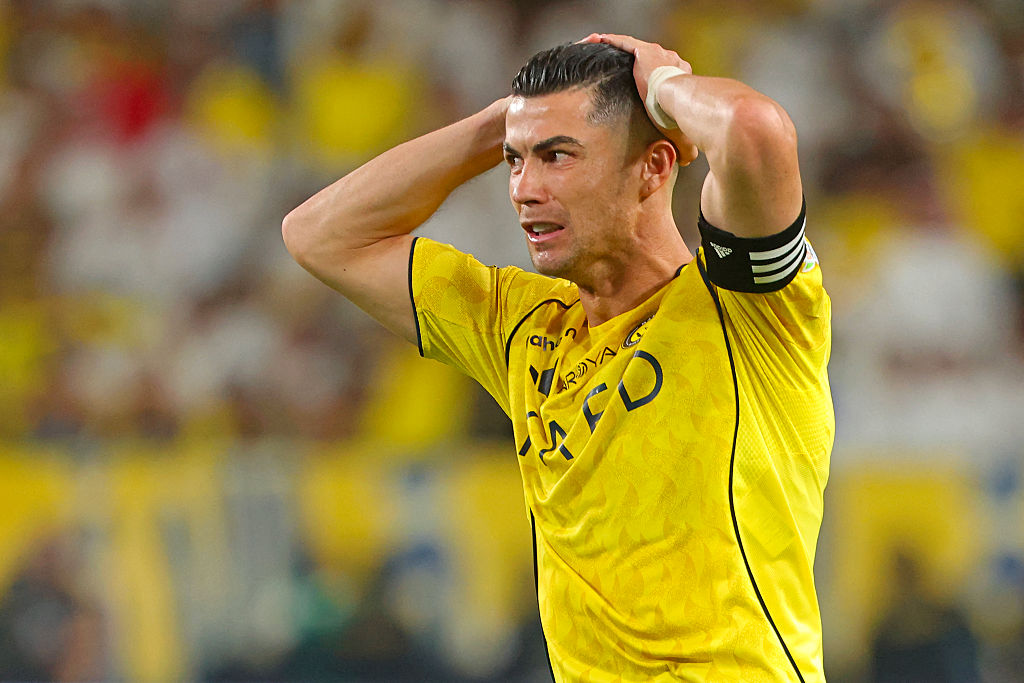
Bento's howler delays CR7's first title in Saudi Arabia 😱
An ugly mistake by Brazilian goalkeeper Bento prevented Al-Nassr from winning the Saudi League title this Tuesday.Cristiano Ronaldo’s team was leading 1-0 until the 53rd minute of the second half,...

























































©
2026